Showing posts with label people. Show all posts

Tuesday, November 29, 2011

Prognostications, Ahoy!

Whitby.  We've heard of the place, on the coast of Yorkshire, home of the madhouse in Dracula, the place with the lightning, the cemetery; the scene of that great Gothic battle against evil.  One imagines it a dreary place, lashed with wind and weather, with dark clouds clinging to the rocky shores.

But Whitby is actually somewhat of a tourist place, and always has been; a place for the people of northern Yorkshire to go to the seaside, an old fishing port (where Captain Cook learned his trade), connected to the North York Moors, where from Georgian times until the present, people go to walk and look.  And Whitby jet, mined there since Roman times, was very popular among the Victorians.

George Merryweather was a doctor living in Whitby, an honorary curator of the Whitby Philosophical Society in the mid-19th century.  His habit of inventing things, so common among the people of the day, led to his invention of the Platina Lamp, a long-burning light source:

"In a communication from George Merryweather, Esq. to Professor Jameson, dated Edinburgh March 5th, 1831, it is proposed to extend the aphlogistic platina lamp, by constructing the body of the lamp, of tin large enough to contain a quart or more of alcohol.  This will be sufficient to keep the platina in a state of constant ignition for thirteen or fourteen days and nights.  Such a lamp, while entirely devoid of glare, affords sufficient light to shew the face of a watch in the dark of night.  ... if it be connected with an unfailing reservoir of alcohol, the lamp may be ignited for years.  The spongy platina does not appear to be, in the least, deteriorated by being kept in a state of constant ignition."

-- The American Journal of Science and Arts, Volume 20, under "Miscellanies"


 However, the thing which Mr. Merryweather became truly famous for was his "Atmospheric, Electromagnetic Telegraph, conducted by Animal Instinct," or, more shortly, his Tempest Prognosticator," which he built for the Great Exhibition of 1851.  It is a beautiful structure, with a bell at the top designed to look like the dome at St. Pauls.  Around the bottom are placed a dozen glass bottles; threading from tiny hammers around the edge of the bell are threads, which connect to a piece of whalebone just inside the neck of each bottle.  Inside each bottle is poured an inch of rainwater and then -- oh happy home! -- each bottle is occupied by a leech.  A common, ordinary surgical leech.

Being a doctor, Merryweather had observed that medical leeches responded to barometric pressure or electrical charge in the air, or whatever it is that allows smaller animals to know when bad weather is afoot.  The leeches' response was to climb -- probably a good response for water-dwelling creatures just before a rain, so that they don't get washed away.  So when Merryweather's leeches climbed to the top of the bottle, they nudged the piece of whalebone, which caused the string to move and ring the bell.  It's not clear, but it appears that the more the bell rang before a storm, the worse the weather to come.

Interestingly, Merryweather knew that his observations would come under question.  He set up a system, using the incredibly efficient postal system of the day, wherein he would post a letter to Henry Belcher, President of the Whitby Literary and Philosophical Society whenever his Prognosticator gave him warning of an impending storm.  Because the postal system delivered mail several times a day, the letters were postmarked with both date and time, proving that he had predicted the storm before it happened.  He did this for all of 1850, and his Prognosticator was surprisingly effective.

The thing that is interesting to me about this invention, which few people actually talk about, is the way in which Mr. Merryweather was working to span that growing gap between the natural world and the newly-ascendant scientific world, using "instinct" as an accurate gauge for something as practical as weather-prediction.  Interestingly, however, meteorology was a very appropriate battleground for this clash, as the scientific method did not always work so well with the chaotic ways that weather systems worked:

"…Faced with problems in constructing meteorological knowledge from the weight of precision observation, meteorologists turned their attention towards kinds of knowledge that stood outside conventional methods and instruments, however extensively situated, however precise and continuous.  The reputation of popular weather wisdom explained how meteorology persistently remained a key site for attacks on the dogmatism of scientific culture, and it forced meteorologists to consider the problem of evidence that seemed to escape the forms of number, weight, and measure." 
-- Predicting the Weather: Victorians and the Science of Meteorology, by Katharine Anderson

In other words, meterologists couldn't simply get by predicting whether people would die at sea based on simple measurements; they had to rely, in some part, on other things they found to be true:

"Eccentric as it may appear, the Tempest Prognosticator embodied widely shared assumptions about forms of knowledge, instruments, and meteorological science.  Its plausibility was based on two key perceptions: first, the precision and infallibility of sensations; and second, the importance of instruments to modern knowledge.  Both are crucial for understanding the relationship of weather wisdom and scientific meteorology.  The complex instinctive behavior of some "lower" forms of life modeled a natural form of automatic precision."
 -- Katharine Anderson, above

I had never really thought before how much the battleground between accepted wisdom/magic and science was fought to a much later date in meteorology, but it makes sense: for, if there's one thing Chaos Theory and satellite technology have taught us, it's that weather is a fickle, far-ranging thing, and telling sailors whether to go risk their lives merely on a barometer is something no one is completely comfortable doing.  Anyone attempting to predict the weather, even today, is likely to come under criticism and even scorn when their predictions appear to be caged in ambivalence; so Merryweather must have thought he was onto something wonderful.  He even tried to convince meterologists that his leeches could be hooked up to a telegraph system, with a minimum of difference in design; but not surprisingly, they did not take the bait.  They already had their feet set on a road in which animal instinct was discounted, and would continue to be discounted, until the late 20th century.

(The Tempest Prognosticator is now kept at the Whitby Museum)


Read more about the Prognosticator

Thursday, December 9, 2010

If Only I Had A Fourth-Dimensional Mirror


Since I've moved house, I've been looking through all my old clothes that have been stashed away for years. I'm one of those people who find really cool clothing and then when they look ridiculous I stash them away until they are reasonable to wear again. It's surprising how many clothes actually do work fifteen years later (as long as they're not bubble gum fashion statements).

One thing that has been striking me over and over recently is the shadow-me that I seem to live with. By this I mean, my younger self, which hangs around in these clothes and in photographs. A tall, slender girl with blonde hair who lacked the confidence to express her opinions. I pull out dresses with the 26 inch waist and think, who was that person? Why didn't she speak up? And I still feel her inside me somewhere, still anxious about things, still idealistic, and she's wondering "what the heck happened to me! I want my body back!" It's like being schizophrenic.


I think I blogged somewhere in Croatia about palimpsests, those places where the information from older times gets layered over newer information. Lately, I'm thinking that people, as creatures who live and grow through time, are really just living palimpsests. Our older selves are simply layered versions of our younger selves. Take a look, sometime, at an older person's face: you'll see every experience they ever had, etched into the lines there. If the person has had a bitter life, their face will show it; and people who live their lives well have a certain beauty, laid into their faces like a mosaic or like those poles with the layers and layers of posters stuck to them.


Have you ever seen or read Flatland (my favorite is the wonderful 1965 animated version, with members of Beyond the Fringe doing voices)? It's about some 2-dimensional people (squares, triangles, etc.) who meet a sphere as it passes through their space. The sphere, as it passes through, appears to grow and shrink as different parts of it are bisected by the 2-dimensional plane, and the denizens of that world think that it's only a circle which appears and disappears and fluxuates in size.


As you can see in the video above (which I found after writing most of this post), we are all multi-dimensional creatures, made huge with the vastness of time's dimension, yet seeing only the three-dimensional slice of ourselves in each moment. The younger me, the older me, the me-that-is-to-be, they are all only aspects of the wholeness of myself. So I really am only looking at a part of the whole when I wonder who that person is/was/will be.

What is the shape of that whole, really? I don't mean just in terms of our bodies moving through space; I mean, who are we? What drives us? How does that inform the multidimensional self?

Up to about twenty, we are growing so much that we can't keep up with our own changes, and as a result every time we meet ourselves we are totally different. We get used to this flux: it's all we've ever known, and we don't generally have the agency to influence the world, so we take it in stride.


However, by the twenties, then, are about being Finished -- about Being A Grownup. People in their late teens and twenties are busy reveling in doing all those things they've looked forward to doing when they became A Grownup: going out to clubs, eating whatever, drinking, staying up late, taking terrible care of their bodies: in other words, going where they want to when they want to -- and reading all those banned books. They smoke, they swear, they talk about exciting new things. They try stuff. They are busy devouring the world and showing everyone how they are Not A Kid.


In their thirties, people tend not to need to prove this point so much, and often settle down a bit, getting involved in their job or family life and generally feeling youthful but settled. Their bodies are still good, their friends are smarter, they are deepening intellectually. Life is good.

Then a weird thing happens in the forties and/or fifties. Suddenly their bodies are betraying them; weird physical anomalies appear as if overnight, literally -- one day they're not there, and the next day they are: weight gain, strange fallen bits, wrinkles and bags and puffy bits you never imagined on yourself, all materialize, one by one, in an avalanche of hellish change. By the time you're sixty or seventy, perhaps you're used to it. I don't know; I'm not there yet. However, it's clear that some people go down fighting all the way.


I used to look forward to getting crow's feet. I thought getting old wasn't such a bad thing, and looked forward to someday being one of those leathery old ladies full of cool stories (as opposed to the unmarked, unremarked face which was my youthful lot). Then one day, for reasons which aren't important but were temporary, I woke up and the space above my eyelids had fallen down over my eyes: I could feel my eyelashes holding them up, and when I looked in the mirror I almost screamed. My eyes had gone from the familiar crooked, normal-sized, expressive and not-ugly eyes to some horrid small and mean-looking ones, the eyes of a stranger. I'd swear it wasn't even me looking out of them.

In that moment, it suddenly occurred to me that this might be what my eyes might look like in old age. Suddenly I was a lot less keen. Where were my same eyes with the crow's feet? Would my eye-skin do this, simply sag over my eyes until I was drowned, lost, subsumed in someone else's face, getting up every morning and looking in the mirror and wondering where the me that I had looked at for years had gone? Was I doomed to look mean forever?

Luckily, the awful swelling passed, but it definitely shook me up.

I remember my 90-something-year-old great aunt -- the one who was married to the painter, who made amazing clothes out of curtains and wrote poetry and called you "Darling" in a wonderful deep voice -- I remember her telling my mom, "You're always sixteen inside, darling." She would flirt with young men and get away with it, because she was so dynamic. The young men always responded -- they were fascinated by her. She was as wrinkly and lacking in hair as the next old lady: but she carried herself with drama, wore interesting clothes, and was a marvelous conversationalist.

The thing is, I always aspired to be her. I thought I wanted to be that cool old lady when I was older. But I didn't realize how hard the journey might be -- to go on keeping hold of who you are when the outside of you changes so much. I'm already one of those people whose outsides and insides have never matched: I used to look in shop windows when I walked by, not because I was vain, but because I could never get used to the idea that that person was me. Initially, it was because I couldn't believe that I was fully-grown and had all the grownup bits; but later, it was more to do with not believing that the person with the blonde mane and the unfinished-looking face was really me. It simply didn't seem like an outward expression of who I was. And yet, as the years go by, you get used to that outer self and you come to see it as a favorite sweater, something comfortable that you wear every day and even dress up with accessories -- like clothes, for example (In my case, later, when I had a few more lines in my face, I dyed my hair red and became much more satisfied with the match between inner and outer selves).

Eventually, however, the sweater gets baggy -- and that's when you suddenly realize you're stuck wearing it even if you find you don't love it so much anymore.

I'm thinking more and more that what you have to do is stop thinking of it as if you are an unhappy consumer who can't buy a new sweater (although many people actually try to get the old one retailored); what you have to do is think of it -- all of it -- as a whole. It's not so much that the outer you has worn out, while the inner you is inside screaming to get out; rather, all of those incarnations of you -- the child, the nubile young thing, the virile strong young man, the parent, the middle aged person, whatever guises you have inhabited along the way -- all of those are actually still there. Literally. You just can't see them anymore.


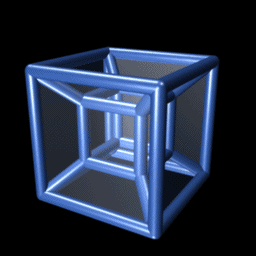
Wikipedia informs me that although I was taught that "Time Is The Fourth Dimension," in most mathematical models there are many different spatial dimensions, and time is not a part of these dimensional spaces. However, there is a type of space (or spacetime) called Minkowski space: "In physics and mathematics, Minkowski space or Minkowski spacetime (named after the mathematician Hermann Minkowski) is the mathematical setting in which Einstein's theory of special relativity is most conveniently formulated. In this setting the three ordinary dimensions of space are combined with a single dimension of time to form a four-dimensional manifold for representing a spacetime.

"In theoretical physics, Minkowski space is often contrasted with Euclidean space. While a Euclidean space has only spacelike dimensions, a Minkowski space also has one timelike dimension."
Et voila! I can still talk about time like it's a fourth dimension. Mathematicians may scoff, but it's just damned easier this way, so I'll willfully stick to it for this post.

Hubble Captures View of
Source: Hubblesite.org
In some version of Minkowski spacetime, then, your tired old body might look like a Nebula photo from the Hubble telescope, or like the best palimpsest you could never imagine. You might find that all the joyous moments shine among the multitudinous wholeness like stars, or that each care that etched its line on your face was represented by a thousand tiny vacillations, like the delicate frills on a jellyfish. You might find that all your many travels make you into a great creature so tangled and enfolded in the Earth that the two have become inextricable. Which gives a new meaning to the "personal responsibility" part of ecological stewardship.

Looking at the women I know who have reached the crone age successfully, I think to myself "it is possible." It's possible to move through the baggy patches with grace, building a beautiful whole. The secret is to live with joy, and the wrinkles in your 3-D self will hopefully layer themselves over the droopy eyes until the palimpsest of happiness embeds itself in your polished old skin so your eyes can't look mean, especially when you look at them in all four dimensions and see who you were, where you went, who you became, and all the many layers and scars and travels and experiences in between, becoming something so vast, so world-encompassing and beautiful that you can't help but be proud.

Friday, July 17, 2009

Social Sewing and Networked Objects


My friend Gwyan sent me a link (via O'Reilly Radar) to a project developed for Microsoft Research's Design Expo, wherein a group of students came up with a wonderful networked object which is designed to be a comfortable improvement for a grandparent. The project is called Social Sewing, and was designed for Despina, grandmother to one of the people in the design group.

Despina was a dressmaker before she retired, working in a shop with several other people, all sewing and gossiping together as they worked. She did this for many years, until it became too hard to get to the shop. Apparently she is still working, but now does it from home – and finds it incredibly lonely work. So the group designed three little sewing-machine-like-objects, with different colored fabrics on each one, which are networked with her friends' sewing machines. When her friends are sewing, the needles on the faux machines go up and down and the wheels go around - with apparently the right sound - and a light goes on to illuminate the fabric, just like in a real machine. When Despina sits in her sewing chair, communication is activated by her weight, and she can talk to whichever friends are sewing at that time, thus making her sewing the interesting gossip-and-sew experience it used to be in the shop. Apparently the friends are all such good seamstresses that they can tell, just by listening to the sound of the others' sewing, what the others are making. By making the devices familiar in shape and sound, the group have enhanced Despina's life dramatically without making her learn anything outside her comfort zone.

For years people have been talking about humanity getting wired into the world, wearing earrings that talk to the bus (and pay the fare) and so on. But I think that is largely chatter. The real impact is going to be in ways like this, where individual people find ways to make their lives better in ways that corporate entities could never imagine. How well would a device like this sell - or perhaps I should ask how many people out there are retired seamstresses? Not many. And yet people like this group, and many of the people who come to events like Maker Faire, are finding incredibly individual and creative ways to use technology - including, as in this case, networking everyday objects so as to make them familiar and fun, without all the learning involved in a designed corporate interface. As far as I'm concerned, this is where combining humanity and technology will have real impact, when we have the tools to design our own technological objects, when the tools are in our own hands to make what we please, in much the same way we knit sweaters or design our own websites. We are all different from any other person; and so, too, should our technology be different. And part of our everyday world, not as "technology", like cell phones or the Internet, but incorporated into our clothes, our knitting needles, the things we like to do. It's where all the personalized interfaces are trying to go, but in a much better, much more interesting way.

(PS. I'll be posting about Maker Faire in the next few days, I hope).

Wednesday, May 20, 2009

Gorey Ways to Be Deflowered


A friend of mine came across this while looking up information about the late, great Edward Gorey. Apparently an early effort, and very silly, but it's fun to know that achieving greatness does not mean an author is immune to silliness. It makes one feel better, rather. It is extraordinary how many possible deflowering situations there are, including By Marimba Player, At Seance, On Cross-Country Bus, In Moroccan Palace, and many, many more.


I first learned about Mr. Gorey's works at age 12 or so when a very erudite student of my father's gave me a copy of Amphigorey. I spent a lot of time trying to puzzle out what was really going on in The Curious Sofa: A Pornographic Work by Ogdred Weary, which really only hints at being pornographic - and does contain such phrases as "well-endowed", which I didn't understand until much, much later.


My greatest regret nowadays is that I did not see the production of Edward Gorey's Dracula, with mind-boggling sets by same, in Massachussetts where I happened to be staying the summer I was sixteen. The starring role was played by Frank Langella, who did a remarkably intense Count in a heartthrob movie version of Dracula: a love story, which of course enthralled me as an adolescent. Nowadays, of course, Mr. Langella is still a very compelling and professional actor, though not quite such a sex symbol.


For the record, one of my favorite Gorey pieces at the moment (they change all the time) is The Unstrung Harp; or, Mr. Earbrass Writes a Novel, in which the unfortunate Mr. Earbrass once again goes through the horrific process of creating literature.


A sample:

"Mr Earbrass has been rashly skimming through the early chapters, which he has not looked at for months, and now sees TUH [The Unstrung Harp] for what it is. Dreadful, dreadful, DREADFUL. He must be mad to go on enduring the unexquisite agony of writing when it all turns out drivel. Mad. Why didn’t he become a spy? How does one become one? He will burn the MS. Why is there no fire? Why aren’t there the makings of one? How did he get in the unused room on the third floor?"

You can find it (expensively) in its own volume, ca. 1953; or you can find it just as pleasant to read in the first volume of the Amphigorey series of his collected works. All hail Mr. Gorey!


A few extra things:

- When I googled Mr. Earbrass, I did come across this search result, which struck me as extremely funny:
Mac Forums - View Profile: Mr.Earbrass
Mr.Earbrass has no contact information. Additional Information, Group Memberships. Song Recs: 0. Mr.Earbrass is not a member of any public groups ...


- Lastly, and apropo of nothing: today is the birthday of Honore Balzac. I heard on the radio he used to have a light supper and go to bed at 5 or 6 pm, then wake up at midnight and write for fifteen hours straight, subsisting on cup after cup of strong coffee. (Well, now you know, why aren't you more productive already??)

Friday, May 15, 2009

The Muse as Moment and Place


This morning I went over to Neil Gaiman's blog to see what was up (actually, I was trying to see what his schedule was for WorldCon, but got distracted by the posts, as usual). He wrote an excellent response to a reader who was complaining about George R. R. Martin not cranking out the next book in a series.

Mr. Gaiman replies, very rightly,

"For me, I would rather read a good book, from a contented author. I don't really care what it takes to produce that.

Some writers need a while to charge their batteries, and then write their books very rapidly. Some writers write a page or so every day, rain or shine. Some writers run out of steam, and need to do whatever it is they happen to do until they're ready to write again. Sometimes writers haven't quite got the next book in a series ready in their heads, but they have something else all ready instead, so they write the thing that's ready to go, prompting cries of outrage from people who want to know why the author could possibly write Book X while the fans were waiting for Book Y."


There is much more than that, of course. But hard on the heels of my discussion of the "I Suck" moment and what to do when the writing needs a rest - and how color helps recharge those tired batteries - it made me think a little further about that process. The nice thing about Mr. Gaiman's post is that he describes the fact that writers have lives. People die, the house needs painting, or your pet needs to go to the vet. This is normal. It is easy to think of writers and artists - creative people - as being these lone madmen who drink too much, staying in their little apartment or cabin (or whatever), creating like a rabid monkey, typing or painting away to the detriment of their health and human relationships.*

This vision, of course, made me have to go find Anne Lamott's great essay about Shitty First Drafts, from her book Bird By Bird, and reread it, again:

"People tend to look at successful writers, writers who are getting their books published and maybe even doing well financially, and think that they sit down at their desks every morning feeling like a million dollars, feeling great about who they are and how much talent they have and what a great story they have to tell; that they take in a few deep breaths, push back their sleeves, roll their necks a few times to get all the cricks out, and dive in, typing fully formed passages as fast as a court reporter...

"Very few writers really know what they are doing until they've done it. Nor do they go about their business feeling dewy and thrilled. They do not type a few stiff warm-up sentences and then find themselves bounding along like huskies across the snow. One writer I know tells me that he sits down every morning and says to himself nicely, "It's not like you don't have a choice, because you do--you can either type or kill yourself."


Sometimes, I admit (much less often than BC: Before Children), I find myself bounding along like a husky through the snow. But usually it's following a long fallow period, where the ideas have been allowed to grow and mate and become fully-formed, and are now dying to get out.


So what is it that makes the muse happen? Where do the ideas come from?

I've often thought of ideas as spores. I walk around with the back of my head hanging open like a cargo plane, waiting for things to drift in. Sometimes I can feel them tickling in there when they alight, but I know by now that if I touch them at that stage they'll wilt. So I do the dishes or water the garden or drive to town, with my inner eye turned back there, peeking hopefully at the little sprouts. And eventually, some die, but some begin to get robust enough to deal with me pawing at them, examining them and even elaborating on them. Sometimes, I'll handle an idea thoroughly and then put it back into the cargo area so that other spores will land on it and change it into something beautiful. Sometimes, it meets another nice idea back there and they get together and have a happy marriage.

But they're never right in front of me. They're always in the back, or slightly to the side. They're rather slippery, and delicate, and they don't like being stared at too hard. They prefer being made concrete via my hands. If I talk about them too much, they fade; and if I get partway through making them concrete and then stop, sometimes they grow in the interim. The robust ones will poke me if I ignore them too long. The really delicate, lovely, strange ones will disappear if I don't do something about them right away, because they're too much like dreams, and don't do well in the workaday world.


In every historical discussion inspiration is seen as being, by its nature, beyond the control of the person being inspired. The Greeks, for example, saw inspiration as coming from the muses, creatures born of either Zeus and Mnemosyne (goddess of memory), or of Uranus (the Sky) and Gaia (the Earth). The muses were seen as repositories of all knowledge from the ancient age, who embodied the arts and inspired the creation process with their graces "through remembered and improvised song and stage, writing, traditional music, and dance." [wiki]

Later, the muses may have lost some of their anthropomorphic properties, but inspiration still remained outside the purview of rational, conscious thought:

"In the 18th century John Locke proposed a model of the human mind in which ideas associate or resonate with one another in the mind. In the 19th century, Romantic poets such as Coleridge and Shelley believed that inspiration came to a poet because the poet was attuned to the (divine or mystical) "winds" and because the soul of the poet was able to receive such visions. In the early 20th century, Sigmund Freud located inspiration in the inner psyche of the artist. Carl Gustav Jung's theory of inspiration suggests that an artist is one who was attuned to racial memory, which encoded the archetypes of the human mind." [wiki]

In American society, which is based more than we would like to think in the puritan, or Protestant, work ethic, the idea that something could be so uncontrollable, so beyond the reach of deadlines and time management, is unimaginable. We think that by eating right, by sleeping right, exercising, having good oral hygene, using underarm sprays and meditating, by learning to schedule play-time and carrying our watches and organizers with us everywhere, we can make sure that all the terrifying alternatives are covered and everything will go as scheduled.


Which is true of many things. But other than clearing some time so that you can clear your head, time management simply doesn't apply to inspiration. Eating, unless you're a restaurant critic, is unlikely to bring the muse. Sleeping enough might give you good, inspiring dreams; but then not sleeping enough could do the same thing. The rest of it... well, there is something to be said for the wild-man-in-the-cabin trope. At least he's not wasting valuable cargo space in the back of his head remembering music lessons and mortgage payments.


The back-to-the-land movement in the late 1960s and 1970s saw people clearing space in their lives to make room for the muse. Like the Puritans in the 1600s, the back-to-the-landers were fleeing what they saw as an oppressive society which did not let them live the life they believed in - one free of music lessons and mortgage payments. Unlike the Puritans, however, they did not believe their choices were shaping their entry into Heaven. They went to the country for much more earthly things - to grow their own food, build their own houses, and make the things they lived with. Most of the people who tried it, though, were unfamiliar with the hardships of rural living, and failed crops, leaking roofs, and lack of money to buy supplies eventually drove all but the most resourceful back to the cities.


Still, this movement planted the seeds for the voluntary simplicity movement, a more mature variation on the theme, advocating sustainable living patterns (solar power, homegrown or locally-grown organic food, and fewest possible consumerist items like credit cards and television, which eat up time and encourage spending).

"Some people practice voluntary simplicity to reduce need for purchased goods or services and, by extension, reduce their need to sell their time for money. Some will spend the extra free time helping family or others... Others may spend the extra free time to improve their quality of life, for example pursuing creative activities such as art and crafts...

"Advertising is criticised for encouraging a consumerist mentality. Many advocates of voluntary simplicity tend to agree that cutting out, or cutting down on, television viewing is a key ingredient in simple living. Some see the Internet, podcasting, community radio or pirate radio as viable alternatives." [wiki]


Unlike the desire in the 1960s to escape Baby Boom America, the new movement is a much more pragmatic desire to remake how we do things. The idea that one can take a breath and step outside the rat-race, take away all the extra parts of one's life - the things one doesn't really need but are paying for because of a perceived lifestyle definition - is not a new one. Epicurus, a philosopher of the fourth century, pointed out that troubles entailed by maintaining an extravagant lifestyle tend to outweigh the pleasure of partaking in it. Henry David Thoreau (another man in a cabin!), was famous for his desire to find a quiet place to write books, where he lived like a hermit (with weekly visits from his mother, who brought him goodies to eat).


Sometimes, though, we are simply tied to the life we have wrought. Not all of us can drop everything and go off to Walden to live alone in a cabin. Many of us have children, and must provide a place for them to live, and food for them to eat. Uprooting everything for a dream is not a simple thing. However, making time to think is not the lazy pursuit we are taught to believe. That mental space-clearing, the opening of the cargo hold and the time for the spores to take hold, is actually sacrament. Don't let anyone tell you otherwise.

Many writers and artists I've spoken to have said that giving the muse a chance to speak is their secret to productivity - in other words, making that moment every day for her to come in and then sticking to whatever comes. One man I knew, a potter, said to my father once, "I've made a deal with myself. I have to go down to the studio every day, and put my hands in the clay. Then, if I don't want to make anything, I can wash my hands and go back to the house. But usually, by the time I've gotten my hands in there, I might as well throw a pot or two." Cory Doctorow said, at Viable Paradise, that you need to make a time every day to write. You don't have to get heroic - 500 or 1,000 words each day will do - but you need to put fingers to keyboard every day. And just like my potter friend, you might find yourself writing a story or two.

Sometimes, though, like Neil Gaiman says, the house just needs to be painted. And then that's your work time, 'cause while you're watching that color spread with the roller, your brain is just going to keep collecting the spores, keep turning the ideas over and looking for worms underneath. So when you go back to the easel or the keyboard, you'll be ready.

"To have laughed often and much;
To win the respect of intelligent people and the affection of children;
To earn the appreciation of honest critics and endure the betrayal of false friends;
To appreciate beauty, to find the best in others;
To leave the world a bit better, whether by a healthy child, a garden patch, or a redeemed social condition;
To know that one life has breathed easier because you have lived;
This is to have succeeded."
- Ralph Waldo Emerson


__________________________

*Until they leave for Africa to become gun-runners.

Sunday, January 18, 2009

Ada Lovelace Day


A friend just sent me this:

"At least one study, and plenty of anecdotal evidence, suggests that women need female role models more than men need male role models. While it's not the only problem facing women in technology, it's a relatively easy one to address.

Suw Charman has put out a call for everyone - women and men - to "come together to highlight the women in technology that we look up to. Let's create new role models and make sure that whenever the question "Who are the leading women in tech?" is asked, that we all have a list of candidates on the tips of our tongues."

She's looking to get 1,000 people to blog about a woman in technology - whether that's IT, publishing, animation, any area of technology! - whom they admire, on March 24th.

Sign up to participate here, or read more about the idea here."

I think this sounds like a very interesting idea. Years ago, when I worked as one of the Webmasters and content writers of a large startup website called Girl Tech (now mostly defunct as far as I can tell), part of my job was hunting down women who made a difference in technology and interviewing them, so that girls ages 8-14 could see how many different kinds of tech jobs were out there. It was great stuff, talking to astronauts and women geologists; completely absorbing. I'd love to revisit it.

Ms. Charman has apparently already reached her goal, but that doesn't mean we can't blog on that topic. I'm going to do it, with or without the pledge. Anyone else?

Wednesday, April 23, 2008

The Romance of Zenobia's Palmyra


While I was looking for Georg Niemann's images of Split ca. 1907 I happened across a reference to Robert Wood's The Ruins of Palmyra, otherwise Tadmor, in the desert (London, 1753), and it actually made me sit up and clap my hands, because Palmyra is one of my favorite places, and to find such a plethora of wonderful images is like getting the best kind of birthday presents.


I went to Palmyra in the early 1990's, before Americans were persona non grata in the Middle East (yes, that recently. We were actually welcome a lot of places back then). I went on a 5-week trip with my good friend Gwyan, who was working in London with me doing graphics at the time, to Turkey, Syria, Jordan and Israel. It was a fabulous trip, and one of the best places was the long-lost desert city of Palmyra, destroyed as an example by a Roman emperor.

We went from by bus from Hamma before going on to Damascus. I remember seeing a many-pointered sign-post on the way of which one of the pointers (pointing off into sandy flatness) said, "Baghdad 413 km" (or something), and feeling completely surreal. When we got there, we were blown away: across the desert, scattered around like toothpicks after a storm, were hundreds of beautiful sandstone columns, statues, carved cornices, and so on - carved from a beautiful orangey stone, like the desert itself. Some of it still stood (or stood again), some of it lay flat, and some was piled up randomly like pick-up sticks.


Nearby was a podunk little town of cement-block housing and boiling-hot, straight, lonely streets crammed up against high earthen walls. Within these walls lay the delicate heaven of the oasis itself: acre after acre of green trees and bushes, surrounded by ditches and pools of water, soaking into the fine desert soil. Where the wall grew lower we would linger, staring at the bounty and the lushness, and wish we could go inside.

The town was full of bored Arabs and on the outskirts, and in the ruins themselves, one could see Beduin folk hanging out, making tea or riding their camels or horses in lovely dark blue robes, the horses or camels arrayed in hand-woven saddlecloths with long tasseled bits. It was almost shockingly romantic.


Several of the buildings in the town housed trinket stores and sold things such as Beduin cloth, souvenirs, postcards of the Godforsaken main street, and any number of other things. I had always wanted a Beduin camel-blanket and found one in a little store run by a young man who looked as if he were about fifteen. After seeing the ruins we went in and bargained with him in a desultory way, drinking cups of sweet tea and discussing the price in a very slow and roundabout flirtation between buyer and seller. After awhile, he heard we were glassblowers and offered to show us his secret room. But more about that below.

Palmyra itself began as an oasis town:

"...[it] was made part of the Roman province of Syria during the reign of Tiberius (14–37). It steadily grew in importance as a trade route linking Persia, India, China, and the Roman empire. In 129, Hadrian visited the city and was so enthralled by it that he proclaimed it a free city and renamed it Palmyra Hadriana." [wiki]

The city is cited in a number of texts (under the name of Tadmor) as having been built by King Solomon, and with Roman conquest grew to be an extremely prosperous and elegant city, with a key part to play in the importation of desirables from the East to the Roman empire.

"Beginning in 212, Palmyra's trade diminished as the Sassanids occupied the mouth of the Tigris and the Euphrates. Septimius Odaenathus, a Prince of Palmyra, was appointed by Valerian as the governor of the province of Syria. After Valerian was captured by the Sassanids and died in captivity in Bishapur, Odaenathus campaigned as far as Ctesiphon (near modern-day Baghdad) for revenge, invading the city twice. When Odaenathus was assassinated by his nephew Maconius, his wife Septimia Zenobia took power, ruling Palmyra on the behalf of her son, Vabalathus. Zenobia rebelled against Roman authority with the help of Cassius Dionysius Longinus and took over Bosra and lands as far to the west as Egypt, establishing the short-lived Palmyrene Empire. Next, she attempted to take Antioch to the north. In 272, the Roman Emperor Aurelian finally retaliated and captured her and brought her back to Rome." [wiki]


Zenobia, known as "the Warrior Queen", expanded her empire and took over Egypt at the age of twenty-nine with her mounted desert-tribe soldiers and a great deal of skill, but was doomed to lose it within a very few years:

"In her short lived empire, Zenobia took the vital trade routes in these areas from the Romans. Roman Emperor Aurelian, who was at that time campaigning with his forces in the Gallic Empire, probably did recognise the authority of Zenobia and Vaballathus. However this relationship began to degenerate when Aurelian began a military campaign to reunite the Roman Empire in 272-273. Aurelian and his forces left the Gallic Empire and arrived in Syria. The forces of Aurelian and Zenobia met and fought near Antioch. After a crushing defeat, the remaining Palmyrenes briefly fled into Antioch and into Emesa.
Zenobia was unable to remove her treasury at Emesa before Aurelian successfully entered and besieged Emesa. Zenobia and her son escaped from Emesa on camel back with help from the Sassanids, but they were captured on the Euphrates River by Aurelian’s horsemen. Zenobia’s short lived Egyptian kingdom and the Palmyrene Empire had ended. The remaining Palmyrenes who refused to surrender were captured by Aurelian and were executed on Aurelian’s orders."


Except for Zenobia: she was taken back to Rome and paraded through the streets in golden chains. Aurelian was so impressed with her beauty, dignity, intelligence and general queenly bearing, however, that he pardoned her quickly and gave her a villa in Tibur (now Tivoli) where she lived in luxury, becoming a respected socialite, prominent philosopher and wife of a Roman governor and senator - and bearing the ancestors of many prominent Roman citizens.

I think this is one of the most interesting stories I know about this time period. And the ruins themselves live up to it, that's the best part. The rug dealer's secret room, however, did not.

It was a tiny room with florescent lighting. All along one wall were shelves and shelves of ancient Roman artifacts - small ones, such as coins and dusty, devitrified little bottles and shards of Roman pottery. "Glass," he told us, gesturing, "Roman glass."

Not my fake: this is what it's supposed to look like!


We looked at the glass with the practiced eye of glass people, and shook our heads, smiling. "This isn't old," we said. "Come on, admit it!" We said this with smiles and the sort of gentle nod-and-wink conspiratorial air of people who had been drinking tea with another person for two days. "No, no, really," he protested, his hands held out palms up, "Roman glass!"

We began to point out all the ways the glass didn't really look like truly aged glass. The oily sheen, we said, that was supposed to be age, wasn't on the surface of the glass, it was somewhere...inside it. We weren't sure how, but it seemed awfully like Mylar stuffed down inside.

He began to grin - he just couldn't help it. He was only fifteen, after all. Picking up one bottle, he showed it to us: "This one, made of a light bulb, cut off on the bottom. The neck - only plastic! See? Easy to melt so the top looks like it's hand-made."

We peered at the thing closely. Covered with a layer of sprayed-on grit, there was a little window for the Mylar to peek out, and the neck really was plastic! We started laughing, and couldn't stop. It was hilarious! A light bulb! Cut off! He showed us some of his other things, and described how it was done. In the end, we bought the light bulb one from him, along with some other ones that we thought were wonderfully inventive - AND the Beduin camel-blanket - and shook hands with him, thanking him for making our trip so much more interesting.

So who was laughing all the way to the bank? Who cares? I still have the light bulb bottle, and it still makes me smile. More, perhaps, than my beautiful pictures of the fabled city of Palmyra.


(The two modern images of the ruins are from an unknown website with beautiful travel photos)

Monday, December 17, 2007

LilyPads and Wearable Electronics


This evening I accidentally came across the website of one Leah Buechley, a woman who may change the face of clothing as we know it.

Long ago, I got a BA in Art, with dual emphases in Conceptual Design (read: early computer graphics and concept follow-through) and textiles. I tried, in every way I knew how, to combine the two: I made weavings out of wires, adding LEDs and plugs; I learned about their new computerized loom, I thought long and hard about how to get computerized technology into fabric. But it was too early, the technology was too clunky, and everyone was looking at me like I was a lunatic, so eventually I gave up.

Imagine my pleasure at coming across Ms. Buechley's wonderful DIY site, where she shows you how you, too, can create amazing interactive clothing with the LilyPad Arduino, a washable, flexible fabric circuit system you sew together with conductive thread, so that your whole body becomes circuitry, and, for example, if you move your arm quickly it sets off LEDs in your clothes. Or: if you put your coat on, your clothes go dark. Take it off, your clothes light up. Best of all, you can use things like snaps to keep the circuitry going when you attach things together.

The RGB LED chages color in response to motion and tilt from the accelerometer which is sewn to the right wrist.


I'm telling you: this woman is smart.

The Arduino is "an open-source electronics prototyping platform based on flexible, easy-to-use hardware and software. It's intended for artists, designers, hobbyists, and anyone interested in creating interactive objects or environments. Arduino can sense the environment by receiving input from a variety of sensors and can affect its surroundings by controlling lights, motors, and other actuators" (See more here).

It's hard to describe how this is different from previous interactive clothing. For one thing, she has come at it from a textile person's perspective, redesigning the whole circuitry thing to look like...well, parts of clothes. For another thing, all the pieces in the group of items (she calls it a "kit", but they are all sold separately) seem to be made as patches, with iron-on circuitry; and there are no wires or weird bits that you have to hide or otherwise deal with (Though the picture of the LilyPad for sale seems harder than the one above. I'll have to find out about that - still, it's not much bigger than a quarter).

Ms. Buechley helps you access the materials, and shows, in clear step-by-step instructions, not only how to use the LilyPad and attendant bits, but things like how to use needle-nosed pliers to turn a regular LED into a decorative sew-on bead, so you can have as many LEDs flashing across your clothing as you want. And she has lots of Flickr pics to look at, too.

She says:

"I am interested in integrating "feminine" activities like sewing with computer science, mathematics and technology. I think that social issues more often than lack of talent discourage women from entering math, technology and science related fields, and I hope to help create environments where women's interests are explored and represented."

Her kits for kids are available for only $15 to make little wearable LED items for themselves (with a little help). I have been trying very hard to find ways to make the robotics curriculum I teach at the local school into something more exciting for girls; their interest, always fickle, waxes and wanes depending on the personality of the students. Not only could we do the kids' kit, but then we could move on to real programming, using the LilyPad itself. This is a sure-fire technological way to get girls' attention, for those of you out there with smart daughters or sisters. In fact, this is a sure-fire way to get my attention. I can't wait to start making stuff.

Finally, after all these years.


Buy the LilyPad development kit from SparkFun

Sunday, December 16, 2007

Rosamond Purcell: Goddess of Wunderkammern

Peter the Great's collection of pulled teeth, probably the most influential picture, for me, ever.


Just found this slide show/article, courtesy of Slate, about my absolutely favorite artist of all time, Rosamond Purcell, a few of whose books I mention in the Christmas list, but who is also the extraordinary contributor to Finders, Keepers: Eight Collectors, and the amazing Illuminations: a Bestiary, both incredible books.


Check it out - it's worth reading and looking at! And if you want to put the above two books on your list, well, I won't stop you.


Link

Also, a marvelous review by John Crowley of Purcell's work.

Saturday, November 10, 2007

All-Star Weekend

Jacopo Bassano's Last Supper


I'm sure we've all had that fantasy about meeting people you admire, and of course the reality is closer to all those YouTube videos of hysterical girls waiting outside Equus to get Daniel Radcliffe's autograph. Or, if you're like me, you're not into screaming and making a fool of yourself, so you see that famous person in a shop, peer at them sideways, wish there was some nice and interesting way to talk to them...but then you shrug and walk away, imagining all the things you might have said to the person, and knowing they were all pretty useless, because the poor person is probably sick of being approached.

So then there's the Dinner Party Fantasy, where you imagine the famous people you might invite to a dinner party. What would make for good conversation? Who would you really like to talk to? Not just because they're cute, or because you have a crush on them or think they're a good writer/actor/movie director/etc. But because you feel there must be a lot of amazing things in their heads, and you'd love to interact with them a little, share stories and so on.

I was trying to imagine this dinner party and I came up with a bunch of names. There began to be enough people there that I knew there would be no way I could really talk to any of them, so I decided it would be a weekend retreat (well, week-long would be better, but these are busy people). I started with live people, and worked my way into dead people...and of course, fictional characters weren't far behind. I did notice that the mean age of the people was surprisingly high, and I tried to think why. All I could think of was that I had chosen people who I've admired for awhile, who had accomplished a lot and who had a lot of life-experience - so if you're thinking I'm ageist, maybe you could suggest someone.

I couldn't possibly think who might sit next to who at meals. Come to think of it, not all these people would necessarily get along; but that's okay, let's assume they would.

In no particular order:

Tom Stoppard, because his brain works in the most amazing loops, he's had an interesting life, and because he's interested in all kinds of odd things;
Ursula LeGuin because I love her books, she's a wise person, and because she grew up in old California, which I'd like to ask her about;
Terry Gilliam, because he's just weird and wonderful, and I'd love to talk to him;
Brian Eno, because he's intelligent and, I suspect, witty and ascerbic, and I like his artworks (as well as his music), and the way he collaborates with other people;
Lori Anderson: what can I say? The woman is bloody brilliant, and I'd be her roommate any day. Dang! I'd give anything to talk to her;
Stewart Brand, founder of the Whole Earth Catalog, starting god of the WELL (early internet community), co-founder of the Long Now Foundation... he has seen and done so many interesting things I can't begin to imagine what I'd talk about with him, only that he must make for great conversation;
Jan Švankmajer, because, well, few people really get to make a name and a living making utterly bizarre and fascinating works;
Neil Gaiman, because he writes great stuff, is prolific and intelligent, appears to be extremely kind, and likes the same stuff I do (and he's a nice dad);
Tim Burton, who makes some of the weirdest (in a good way) movies and has the best eye I've seen for oddness and style, though I'm not certain about his conversation skills;
Diana Wynne Jones, who writes insightful books with an unparalleled ability to create plots that defy the ruts that so many fantasy stories fall into, and who I would think would be the same to talk to;
Youssou N'Dour, who just fascinates me, I don't know why;
John Crowley, whose Little, Big made an inexplicable and everlasting impression on me when I read it, twenty-five years ago, and who seems able to think in both macro- and micro-vision at once;
and Faith Ringgold, who makes such amazing stories with her quilts.


Now, here's some dead people:
Joseph Cornell: I don't know much about the man, but his boxes had a lifelong effect on me - and were the beginnings of a fascination with boxes and an eventual interest in Wunderkammern;
Jane Austen, because good Lord! Have you ever seen anyone better able to dissect people with absolute sweetness and deadly precision?;
James Thurber, because he was very silly in a very smart way (except when he was serious);
Thorne Smith and Dashiel Hammett, for their dazzling wit;
Claudette Colbert, because she can talk faster than anyone I've ever seen;
Ibn Ismail Ibn al-Razzaz Al-Jazari, because aside from being the product of a brilliant and lost civilization, he was incredibly brilliant himself - and left us some really beautiful documentation of it;
Sir Henry Bessemer, because he was a wonderful raconteur and a fabulous engineer who was not only willing to take risks, but bull-headed enough to make others at least try his inventions.
H.G. Wells, who might have been a weirdo in his own time, but wouldn't you love to be able to pick his brains?;
and Edith Wharton, to stir things up a little.


Here are some fictional people who I think would do well in the mix, or at least who I'd like to get to know better:
Tenar, from Tehanu and the other (later) Earthsea books, because she is insightful and wise and very strong in all the right ways;
Scheherazade - of course! Not only because she tells great stories but because she's smart and interesting, too;
Hobbes, as in "Calvin and" - but in his non-stuffed form, of course, because I've had a crush on him ever since he appeared in print;


Hopey and Maggie, from Locas, because they were a big part of my life for a long time, and I always wished they were real (especially back when they fixed rockets for a living);
Mina Harker, because even if she ends up being a kind of a prude, she's still pretty cool.
Harlequin and Columbine, a fascinating and quixotic couple guaranteed to spice up any gathering.

I suspect there are actually many, many more good house parties out there, but I'm still writing NaNoWriMo and couldn't possibly spend more time thinking about it. Any further suggestions?

(PS. for an interesting Google-Earth style look at the last supper, check this out)

Friday, September 14, 2007

A Wonderful, Eccentric, Brilliant Man (and His Book)


My father first bought this book in England in the 1950s, when he traveled to the UK to research his family tree in Scotland. My father is a Scots-Canadian, raised in Detroit, and a cartoonist at heart. He knew of Rowland Emett from Punch, and this book caught his fancy.

As a child, I found the book stuck into the bookshelf next to things like The Electric Koolaid Acid Test and Lord of the Rings (original binding, since my dad was the kind of person who was reading that stuff when it was published), and someone's cast-off version of Fear of Flying. which I suspect neither of them had read. I would read Nellie and marvel, in that way kids do at the age where they believe everything: at the wonderful elevated railway, which caught my fancy:

along with all the other wild and amazing adventures. I tried for years to make a twin-funneled paddle boat out of branches and string, like they did, but I never won any races.

The book captures some essential thing about being provincial, and English, and loving trains, particularly the small locals, which in the early 1960s Dr. Richard Beeching eviscerated, cutting nearly all the little local lines (and going down in infamy for its effect on the British way of life). Albert Funnel and Frederick Firedoor, Nellie's driver and "guard-fireman-and-porter", become upset because nobody in Cloud Cuckoo Valley or Duckwallow Marsh appreciate them, and so they get a wonderful idea: to turn Nellie into a flying machine and go somewhere else. They touch down in New York, where the members of the Philharmonic use parts of Nellie for a concert; then they look for some tracks heading South.

"They took Nellie down to the tracks, but were most upset to find she wouldn't fit and while they were wondering what ever to do they were gently scooped up by the cowcatcher of the Elmer K. Pheffenfeifer, which was just pulling out for the Deep South."

As you can see, American trains are of an entirely different order than that of small local English ones:


In the Deep South, Nellie becomes a paddle-boat for awhile to help one captain win the Grand Torchlight Race, then heads West where they rescue a damsel in distress who turns out to be part of a movie set (with a cardboard train about to run her over), and end up in the Smoky Patch Mountains, helping the tired gold-miners to mechanize their mining and their entertainment (using Nellie, of course), earning their fortunes and bringing back a miner friend to England (which they get to by buying diving gear and following the undersea telegraph cable).

These divers are repairing the undersea telegraph cable with knitting needles. Note the bag of gold dust which they exchanged to Nellie's crew for diving gear, and the curtains inside the one man's helmet, which fascinated me as a child


The drawings are marvelous, spidery and full of little odd details, and completely fanciful, playing beautifully off the English preconceptions of America at the time.

So now I come to the part that thrills me. Just on the basis of this book, in the interests of this post, I went and looked Rowland Emett (sometimes called Roland Emett) on Wikipedia. What I saw there just blew me away: the man built all kinds of amazing machines, which showed in places like the 1951 Festival of Britain (for which he made a physical model of Nellie, among other wonderful machines) - and he designed the machines for the movie of Chitty Chitty Bang Bang.


His SS Pussywillow (a mind-boggling machine) was featured on Brass Goggles, which is appropriate: his mechanical creations would appeal, for good reason, to the Steampunk community. The man was a total eccentric, with a marvelous imagination, and I feel privileged to have known this little story of his all my life. I still think it might be the coolest thing he did.

And I have to wonder: did Mr. Emett see something like Beeching on the horizon? Did he hope, in that lost way we writers have, that by encouraging this little bit of wonder and love for the tiny locals, he might help to save them? I suspect even in the early 1950s there was talk of trying to make the train system more efficient. Anyone who loves trains, especially the ones that get stopped by bicycles at crossings, must be influenced by the lovely fancy of this book - must see that the loss of trains like these, that went to places like Starfish Point, could only be a loss to the world at large. And if a gentle influence could have saved them, it would have been this one, for clearly, Mr. Emett understood about wonder.


More links:
- Rowland Emett machines: photos
- All kinds of info about him, including a timeline of his works and life