Showing posts with label art. Show all posts
Tuesday, February 14, 2012
Shades of Old Detroit
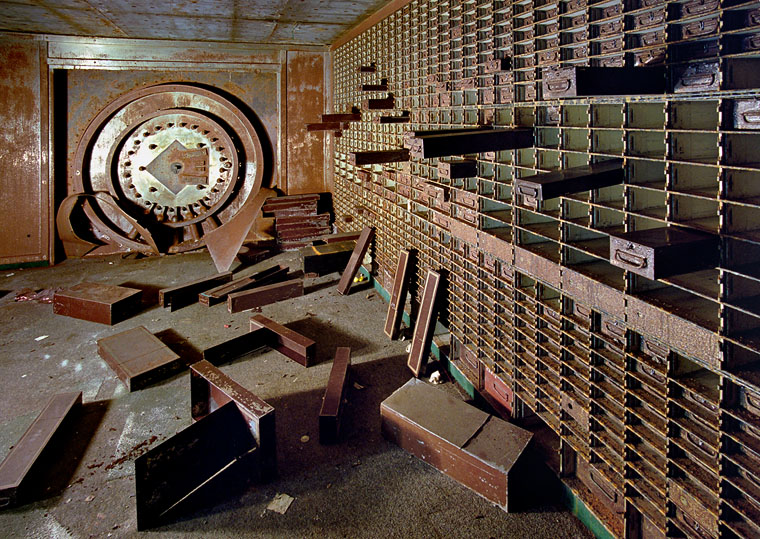
I just came across this while looking for something else in Google images: a project by Yves Marchand and Romain Meffre, called The Ruins of Detroit, a 5-year collaboration between 2005 and 2010. This is part of what they have to say about the work:
"Detroit, industrial capital of the XXth Century, played a fundamental role shaping the modern world. The logic that created the city also destroyed it. Nowadays, unlike anywhere else, the city’s ruins are not isolated details in the urban environment. They have become a natural component of the landscape. Detroit presents all archetypal buildings of an American city in a state of mummification. Its splendid decaying monuments are, no less than the Pyramids of Egypt, the Coliseum of Rome, or the Acropolis in Athens, remnants of the passing of a great Empire."
My father grew up in Detroit in the 1930s and 1940s, worked in the auto factories during the summer, and went to the grand movie houses during the height of the movie era. I have always wanted to visit the Detroit of his youth, and looking at these pictures is, in some ways, like looking at him: under the age are traces of a marvelous youth, a grace and power that still speak to us, despite the passage of time. It's both breathtaking and heartbreaking to see these remains of another era. Particularly, I find the image of the theatre to be beautiful and sad.
Friday, January 13, 2012
The Secret of Kells
I just watched The Secret of Kells tonight. I've had it on my list for a long time, and thing after thing has thrown itself in the way of my watching, but tonight I had a time limit. And that was when I said, "Hey, I've been meaning to watch this for a long time. C'mon, I've heard it's good."
I managed to overcome much grumbling from the other members of my household and force them to watch this instead of an already-seen Dr Who episode. We sat back and prepared to be entertained. And that's when the color and complexity of Kells burst over our eyeballs and we sat, entranced, none of the usual trips to the bathroom or other interruptions for the full hour and a quarter of the movie.
The story is about a child named Brendan who is growing up in the Kells monastery in Ireland, run by his uncle, who is building a huge wall to keep the Northmen out. They take in a refugee from Iona, a tiny island off the coast of Mull, in western Scotland, where the Northmen have attacked and left no one alive. In his keeping is a book, the Book of Iona, whose pages are filled with the majesty of generations of work; but the book is unfinished.
The refugee, a monk with the gift of fine illumination, asks the boy to go into the forest to find some oak-berries (probably mistletoe) to make green ink with, so for the first time, Brendan leaves the safety of the monastery and goes among the trees. There, he is saved from the wolves by a girl who tells him to get our of her forest. He accuses her of being a fairy, and she does seem to have a magical quality, flitting through the trees and making flowers grow; she gives her name as Aisling, and she consents to help him find the berries if he will then leave the forest and not come back.
Of course, they end up becoming friends, and Brendan goes back to learn illumination, against his uncle's will. His uncle is obsessed with building a wall strong enough to keep the Northmen out, and does not see as his nephew begins to learn to create incredible illuminations, with the help of a magical glass which he wins from Crom Cruach, a pagan god whom St. Patrick is said to have overcome.
The extraordinary thing about the animation is the way in which you emerge at the end, feeling that you've just swum through the most marvelous illuminated manuscript. The attention to detail, and the careful attention paid to Irish art in its execution, is overwhelming. Apparently, the animators took a leaf from Mulan (which uses Chinese art as an inspiration) in its conception, and it works; the film is lovely, and very Celtic.
Throughout the film, too, are side-references and little references which, like the endlessly complex illuminary graphics of the film, thicken it into layers of meaning. For example, the cat, Pangur Bán (whose name means White Fuller in Gaelic) comes from an Old Irish poem, written in the 9th century by an Irish monk at Reichenau Abbey, in southern Germany:
I and Pangur Bán, my cat
'Tis a like task we are at;
Hunting mice is his delight
Hunting words I sit all night.
Better far than praise of men
'Tis to sit with book and pen;
Pangur bears me no ill will,
He too plies his simple skill.
'Tis a merry thing to see
At our tasks how glad are we,
When at home we sit and find
Entertainment to our mind.
Oftentimes a mouse will stray
In the hero Pangur's way:
Oftentimes my keen thought set
Takes a meaning in its net.
'Gainst the wall he sets his eye
Full and fierce and sharp and sly;
'Gainst the wall of knowledge I
All my little wisdom try.
When a mouse darts from its den,
O how glad is Pangur then!
O what gladness do I prove
When I solve the doubts I love!
So in peace our tasks we ply,
Pangur Bán, my cat, and I;
In our arts we find our bliss,
I have mine and he has his.
Practice every day has made
Pangur perfect in his trade;
I get wisdom day and night
Turning darkness into light.
(Translated by Robin Flower)
Which is excellent, because the movie begins: "I have seen the book which turns darkness into light." And, of course, a large part of the movie takes place in the Scriptorium, where the illuminations are created, and where, I suspect, our nameless Irish monk was when he wrote the poem. It's also possible that the author was from Iona, which was repeatedly sacked: a lot of the people fled, many to Ireland, but many of them went to the Continent to set up Columban monasteries. So you see the references are circular, like an Irish knot, or a snake swallowing its tail, or a fine illumination.
Interestingly, there was a Saint Brendan, but he lived many years before Iona was even founded, so not all trails lead back round to the beginning. But then, though art is about truth, it's not always about having the facts straight.
And just to give you an idea what they're talking about when they go on about the wonder of their book, here are some images from the real Book of Kells (its final name), which lives
Here is the page called the Chi Rho page, meaning the first two letters of the word "Christ" in Greek.
A detail from that same page, near the top.
And just to drive you crazy, here are two cats and their kittens worked into the bottom, in the reddish bit by the lowest part of the P shape. Look carefully (try clicking on the image to see it in more detail). See all that insane detail inside all the other bits? The interwoven curlicues under the cats' feet? That is all miniscule work, which could not have been done without at magnifying glass (the crystal? From the eye of Crom Cruach?); the Chi-Rho page in total is about the size of an 8 1/2 by 11 inch piece of paper. Imagine trying to do that with 8th or 9th century technology, quill pens and such.
This page, by the way, shows up in the movie, so watch out for it. And watch out for all the pieces and parts of the page to appear all through the movie as part of the storyline. It's quite a work of art -- the movie as well as the book.
Good luck -- you're in for a treat.
Tuesday, December 6, 2011
Tyger, Tyger in a Folded World
I just came across this, pretty much by accident. It's amazing, a small film by Guilherme Marcondes, a Brazilian filmmaker, based on the William Blake poem. He uses puppetry, illustration, photography and CGI to make a fantastically rich little gem:
Mr. Marcondes is influenced by the pastiche of Brazilian culture and the DIY quality of the Brazilian film schools of which he came. Clearly, he uses anything he can get his hands on, including things like origami and the ancient Japanese puppet-art of bunraku. It's all very stylized and fabulous, and makes me want to know more about his earlier life -- did he study all these kinds of art? He must have.
I went to his website, where he has samples of his work, and I found this, from a movie called Bunraku, the opening sequence of which he was given carte blanche to do:
I never heard of this movie, Bunraku. It looks like it was released in France and Canada, but not here...? It looks like a very violent movie, definitely not my type of thing, but the art direction looks really interesting: the pans through cities seem to unfold like a pop-up book, and the scenery is an odd conglomeration of bits. Which leads me to the fact that Mr. Marcondes originally studied architecture:
"I like experiencing architecture, not practicing it. Just as I go to the movies or listen to music, I like to wander around a city, paying attention to how the space is organized, how the transportation works, etc. I’m interested in how the environment we live in changes and conditions our personalities. That’s clearer in Tyger than in any other film I’ve made. That also explains why I like J.G. Ballard so much!" [link]
And on that note, I will leave you to ponder a world where cities are made to pop up as you move through them, and when the apocalypse comes, flowers of light grow through the cracks of the world.
Thursday, January 27, 2011
Why Cheap Art
If you have not seen this, you should. I have a poster of it up in my house, and have read and re-read it for years. I like it, and I'm still not tired of it. I bought it at the Cheap Art Store on Divisidero in 1989, a place that sold truly cheap art (that really was art) but didn't last that long.

'Nuff said.

'Nuff said.
Saturday, July 31, 2010
More in the Way of Hands, Mechanical

Since I've been on the subject of waldos, and making things by hand, I might as well show a few of the myriad interesting images I've come across. The hand can be interpreted in so many ways.

First, an amazing clockwork hand manipulator, which I would love to have, even if it's really simply art for art's sake. However, imagine if this could read Jacquard cards (or complex cams) and thus make your hand move in specific ways. Gives a new meaning to the term "player piano" - or perhaps, "piano player." Which would it be?
And a YouTube video of how it works:

Shane Willis' cool Escher-inspired hands repairing each other.

Part of a school project where students had to build working hands out of popsicle sticks and strings as a study of engineering and physiognomy.

A Becker Lock Grip hand, modded by the writer of a blog on "Technical Below Elbow Amputee Issues." In fact, modded twice. Really a very nice hand to have if you need a prosthetic arm, because it is so moddable (and cool looking). An interesting discussion, too, of people's reactions to different prosthetics he's tried... And a neat video of him using it to chop tomatoes.

(Editor's note: Wolf Schweitzer, author of the Technical Below Elbow Amputee Issues blog, above, has written to tell me that I must include the beautiful Monestier-Lescoeur hand, made by a sculptor and automata maker who does very interesting work. He's right - check it out: you can see the video here)

Another school project, with instructions
.jpeg)
Kroenen's Mechanical hand, a reproduction of the one in the movie Hellboy.

A cheap mechanical hand ($17) which I came across on BoingBoing
I wasn't able to get a copy of this amazing tattoo of a hand emerging from this person's flesh, but I encourage you to go look at it.

In the Waldo tradition, this person made an oversized wooden hand to fit on their arm

Lastly, Ambroise Pare's excellent rendering of a mechanical hand, made from the original but with metal parts inside. From a nice Timeline of Robotics website.
The picture at the top was in Google Images, but led to a site which proposed to scan my computer for viruses, and nothing more. So I snagged the image and got out of there...
Saturday, March 20, 2010
Diorama Extravaganza

Long, long ago, Nicholas Clayton wrote in to tell me this:
"Going off-post to point you to something that should intrigue any enquiring mind that is prepared, as yours evidently is, to be delighted. I can't find any note of it in your blog: the London Diorama.
Sitting in a taxi I saw the name blazoned on the pediment of the Nash terrace at Park Square East. This led to a fascinating article (The Diorama in Great Britain in the 1820s).
And the Diorama structure of building is still there behind the facade as can be seen on the Google satellite view [see picture]. I have yet to visit to find out how accessible it is to the public."


The diorama was a sensation in the early 1800s, the brainchild of Louis Daguerre, as in (you guessed it) the daguerrotype. Having apprenticed in architecture, theater design, and panoramic painting, M. Daguerre was a natural talent with a true skill for theatrical illusion. He became famous for his electrifying theater design, and at the age of 35 opened his first Diorama in Paris in July 1822.

"...the Diorama was a theatrical experience viewed by an audience in a highly specialized theatre. As many as 350 patrons would file in to view a landscape painting that would change its appearance both subtly and dramatically. Most would stand, though limited seating was provided. The show lasted 10 to 15 minutes, after which time the entire audience (on a massive turntable) would rotate to view a second painting. Later models of the Diorama theater even held a third painting.

The size of the proscenium was 24 feet (7.3 m) wide by 21 feet (6.4 m) high (7.3 meters x 6.4 meters). Each scene was hand-painted on linen, which was made transparent in selected areas. A series of these multi-layered, linen panels were arranged in a deep, truncated tunnel, then illuminated by sunlight re-directed via skylights, screens, shutters, and colored blinds. Depending on the direction and intensity of the skillfully manipulated light, the scene would appear to change. The effect was so subtle and finely rendered that both critics and the public were astounded, believing they were looking at a natural scene." [wiki]
Here is part of a review of one of the dioramas shown in London, from The Times, 4 October 1823:
“The warm reflection of the sunny sky recedes by degrees; and the advancing dark shadow runs across the water – chasing, as it were, the former bright effect before it. At the same time, the small rivulets show with a glassy black effect among the underwood; new pools appear which, in the sun-shine, were not visible; and the snow-mountains in the distance are seen more distinctly in the gloom. The whole thing is nature itself; – and there is another very curious sensation which this landscape-scene produces on the mind. The decided effect of the thing is, that you look over an area of twenty miles; the distant objects not included. The whole field is peopled: a house, at which you really expect to see persons look out of a window every moment – a rill, actually moving – trees that sem to wave.
You have, as far as the senses can be acted upon, all these things (realities) before you; and yet, in the midst of all this crowd of animation, there is a stillness, which is the stillness of the grave. The idea produced is that of a region – of a world – deserted; of living nature at an end; – of the last day past and over. Silence, in spite of Ariosto, seems to have found a resting-place – nay, at last, an empire – upon earth.”


The diorama in London was built the year after the first one in Paris, in 1923.
I did a bit of web-burrowing and came up with this information:
Arthur Gill (who throughout the 1960s and 1970s wrote a regular column in The Photographic Journal of the Royal Photographic Society) recorded an account of a visit he made to the Park Square East/ Peto Place building at a time when it was empty in the mid–1970s. He found what seemed to be the remnant of a filled-in well of about twelve feet (3.7 metres) diameter which he thought was originally used to contain the turning shaft on which the Diorama saloon had turned. A few years before, when the building housed a department of the Middlesex Hospital, the well had been filled with warm water and used for hydrotherapy of disabled patients. Mr Gill explored fully the empty building and “tried to imagine what the aspect would be like if the circumferential rooms and offices were absent... However, try as I would, my imagination was unable to sweep away the modern amendments and adaptions, and recapture the Diorama. Except for that concrete–filled well ... everything has gone beyond recall”. (Arthur Gill, ‘The London Diorama’, History of Photography, January 1977, Vol. 1, No. 1, pp.31-36)
In the early 1990s it was being used to house the Diorama Arts centre, but later it became part of the national headquarters of The Prince's Trust charity. Lord knows what's inside the structure now.
Daguerre went on to build other dioramas, the last one being a diorama in a church in Bry-sur-Marne, just outside Paris, where he lived. Last time I was in France I tried to get there because they still have one hanging in the church; but apparently it was poorly restored over the years, and now they are trying to restore it from the restoration, so to speak, having lost a good deal of the transparency and effect in the previous restoration.
Daguerre, of course, was fascinated by visual representation in all forms, and ways of reproducing the reality of the world in a more permanent, frozen form. It was not surprising, then, that he became involved in the first photographic process:
In 1822 Joseph Nicéphore Niépce produced the world's first permanent photograph (known as a Heliograph). Daguerre partnered with Niépce three years later, beginning a four-year cooperation. Niépce died suddenly in 1833. The main reason for the "partnership", as far as Daguerre was concerned, was connected to his already famous dioramas. Niepce was a printer and his process was based on a faster way to produce printing plates. Daguerre thought that the process developed by Niepce could help speed up his diorama creation.
Daguerre announced the latest perfection of the Daguerreotype, after years of experimentation, in 1839, with the French Academy of Sciences announcing the process on January 7 of that year. Daguerre's patent was acquired by the French Government, and, on August 19, 1839, the French Government announced the invention was a gift "Free to the World."
Daguerre and Niépce's son obtained a pension from the Government in exchange for freely sharing the details of the process.
The Wikipedia article on dioramas says that Daguerre was a manufacturer of mirrors, which is interesting for several reasons. One is that the plates on which the daguerrotypes were developed used a silvered surface; another is that his cameras depended on taking the light that came through the camera's lens and reflecting it with a mirror onto the plate, very much like a camera obscura. He never developed this camera much, and depended on this same essential concept for his patent. All part of the smoke and mirrors of good theatre, I suppose.

Many thanks to R.D. Wood's extensive work on the history of the diorama.
Friday, February 26, 2010
Rural Old New York

Janice McIntire just sent me a link to a New York Times article about a man who has spent 30 years turning his 1-bedroom Manhattan apartment into a rustic cabin á la Abe Lincoln. Check out the amazing interactive tour, which allows you to see a panorama of both his living room and his kitchen. I took a couple of screen shots just to give you a taste (check out the computer in the kitchen, and don't forget you can look at the ceiling and floor).
The things one can do if one has enough time! Who says Steampunk is a recent development? It's been in the works a long time.

Thanks, Janice! (via Bettershelter)
Saturday, August 8, 2009
MetaHaiku

"Cent mille milliards de poemes" (A hundred thousand billion poems), by Raymond Queneau
For a number of years I've been really interested in the possibilities of hypertext as a vehicle for really interesting and complex narrative. I diddled around with writing stories in hypertext, but was never satisfied with the result; they seemed to me either confusing or aimless or simply mechanistic, and at best I came up with something so voluminous that I couldn't possibly complete it in one lifetime.
I decided to try poetry instead.
Poetry has the virtue of being all about simplicity, about using as few words as you can to create complex images and ideas. It's about making little windows into reality, places where the world stops for a moment and you see, really see, something unexpected.
It's really a perfect place for hypertext, being spare and clear and often having a specific structure. And there is a long history of what is called combinatorial poetry, or combinatorial text - the creation of poems that can be changed around by the reader, usually based on some mechanism in the book form. I decided that I would try haiku, since the form is so fixed. This would a) allow me to work within a specified framework, so I didn't have to also create (and get tangled up in) my own system; and b) would keep the poems from wandering off on a tangent, keeping them simple and clear. I also decided I would specify the number of links so as to keep it as structured as a traditional haiku.
What I came up with, using the simplest tools I could, was an HTML frameset system in a set window size. The top frame held the top line, the middle frame held the middle line, and the bottom frame held - well, you get the picture. Then in each line I chose one word which would be emphasized, making that the link word. When the reader clicks on that link, the line changes, creating a new haiku. (more about my process here)
It's difficult to describe it, and I can't actually insert one here in the blog, so I suggest you try one. Here's my little MetaHaiku site, where you can see a few that I've written.
The thing I like about these is that it enlarges the tiny window of a haiku without compromising its essential qualities. By nature, haiku are traditionally supposed to describe a moment, and they are supposed to contain some clue about season, and they are supposed to speak only of small things - which of course capture something much larger. So when you make a haiku with hypertext, you are creating a series of moments, a progression of snapshots which move slightly through time, describing a longer moment than a regular two-dimensional haiku. It's not so much that they describe more as that they describe longer, and the reader can unveil the moment in a way that is pleasingly exploratory.
The haiku have five links on the top line, seven on the middle, and five on the bottom, echoing the syllabic line-structure. The experience is a lot like our experience of real moments - in other words, you can't go back. There is a starting haiku and and ending haiku, and any number of ways to get there. In the present structure, you have more than 175 ways to get from the beginning to the end, so the process is surprisingly repeatable.
What I've decided is that I'd really like to share these, and see if others are interested in writing some. What I'd really like to do is to find a simple way to do it, given that mine are done in a clunky and complicated way, and then broadcast the template for everyone to use. I'm working on having a friend make a Flash interface to simplify things, but in the meantime if anyone wants to know the more lame way I did it you can email me (look in the sidebar for the address) and I'll do my best to define it for you.
Vive la Interactif!
Friday, July 17, 2009
Social Sewing and Networked Objects

My friend Gwyan sent me a link (via O'Reilly Radar) to a project developed for Microsoft Research's Design Expo, wherein a group of students came up with a wonderful networked object which is designed to be a comfortable improvement for a grandparent. The project is called Social Sewing, and was designed for Despina, grandmother to one of the people in the design group.
Despina was a dressmaker before she retired, working in a shop with several other people, all sewing and gossiping together as they worked. She did this for many years, until it became too hard to get to the shop. Apparently she is still working, but now does it from home – and finds it incredibly lonely work. So the group designed three little sewing-machine-like-objects, with different colored fabrics on each one, which are networked with her friends' sewing machines. When her friends are sewing, the needles on the faux machines go up and down and the wheels go around - with apparently the right sound - and a light goes on to illuminate the fabric, just like in a real machine. When Despina sits in her sewing chair, communication is activated by her weight, and she can talk to whichever friends are sewing at that time, thus making her sewing the interesting gossip-and-sew experience it used to be in the shop. Apparently the friends are all such good seamstresses that they can tell, just by listening to the sound of the others' sewing, what the others are making. By making the devices familiar in shape and sound, the group have enhanced Despina's life dramatically without making her learn anything outside her comfort zone.
For years people have been talking about humanity getting wired into the world, wearing earrings that talk to the bus (and pay the fare) and so on. But I think that is largely chatter. The real impact is going to be in ways like this, where individual people find ways to make their lives better in ways that corporate entities could never imagine. How well would a device like this sell - or perhaps I should ask how many people out there are retired seamstresses? Not many. And yet people like this group, and many of the people who come to events like Maker Faire, are finding incredibly individual and creative ways to use technology - including, as in this case, networking everyday objects so as to make them familiar and fun, without all the learning involved in a designed corporate interface. As far as I'm concerned, this is where combining humanity and technology will have real impact, when we have the tools to design our own technological objects, when the tools are in our own hands to make what we please, in much the same way we knit sweaters or design our own websites. We are all different from any other person; and so, too, should our technology be different. And part of our everyday world, not as "technology", like cell phones or the Internet, but incorporated into our clothes, our knitting needles, the things we like to do. It's where all the personalized interfaces are trying to go, but in a much better, much more interesting way.
(PS. I'll be posting about Maker Faire in the next few days, I hope).
Thursday, April 30, 2009
Leafcutter Designs: Large Concepts in Small Packages
Trade tokens: the best kind of friendly economyI've been receiving notices from Leafcutter Designs for a long time, but recently went back to visit (finally), and was blown away by the creativity and joy in its wonderful pages. It's interesting, because it combines conceptual art and actual goods and services for sale. Really, a perfect example of someone getting creative in their work, and making art pay.
Lea Redmond is the driving force behind it, and runs it like the tiny business it is. The welcome says, "we live upstairs on top of this online shop and you can holler up to our kitchen window where a pie is sitting on the windowsill."
The items for sale started as small things she made for friends and family which became so popular that, as the website says, "we decided to make a bigger batch." The ideas are all ecologically sound, everything they present seems to have both a micro and macro emphasis (in other words, using tiny things to emphasize and talk about larger concepts), and every one of them is made or thought up with the idea of joy in mind - not the sale of joy, but actual joy, the kind where you do good things for other people and have fun doing it, or the kind where you simply get curious, get playful, and enjoy the basic physical wonders of living. Which is the main reason why I like them.
For example, she has created a series of conceptual knitting patterns. I like the sky scarf, where you buy a bunch of yarn in all the colors the sky could possibly be and then knit two lines of whichever color matches the sky every day. After a year you have a record of the sky - and a scarf!
Another favorite is the BART scarf, based on a local train system, the Bay Area Rapid Transit, in which you get yarns the color of the different BART lines and knit in that color whenever you are traveling on that line. Whenever you change lines, you change colors.
Other wonderful services and items are such as these:

- Earrings for Spontaneous Seeding: "You never know when an opportunity for planting might present itself." Refillable, of course.

- Recipe dice: Roll these to decide what ingredients to use in dinner. They are 5/8" across and "feature seasonal vegetables (different dice for each season), grains, meats, spices, herbs, and a few additional ingredients like lemon, ginger, and hot chiles."

- Wiggly Eye Dice: wooden dice with wiggly eyes for dots. Weird and fun.

- The World's Smallest Postal Service, which began as a tiny post office which Ms. Redmond set up in cafes and other places. If you gave her a letter, she would transcribe it "on a miniature desk in the tiniest of script, sealed with a miniscule wax seal with the sender's intial pressed into it, packaged up with a magnifying glass in a glassine envelope, and finished off with a large wax seal." Nowadays you can order the letters online (though they are no longer hand-written), and she has a variety of timely variations, such as Mother's Day cards. Imagine receiving a letter smaller than a quarter in the mail! Magical. Good for Tooth Fairies and other small creatures, as well.

You can also find out about the history of flour sack clothes, undergo creative courtship consulting (or tell stories of your own in the Project section), get poetry ribbon, and many other things. The Project section is full of broadcast-style art pieces where you can submit your own electronic postage stamp design, send her artifacts for the Game of Infinite Possibilities, make a rolodex card of something you love or think about for her rolodex machine, and several other participation-based fun art activities.
You can read Ms. Redmond's blog here.
Labels:
art,
blogs,
contemporary,
games,
metaphor,
miscellany,
neat stuff,
tiny
Thursday, February 19, 2009
Lunokhod and the Art of Space

I recently wrote a short story in which the archeologist protagonist is on the Moon, years after the human race is dead, looking at the human leftovers there and wondering about our culture. While researching the items that were left there by our astronauts, I came across this image of Lunokhod 1, sent in November 1970 by the USSR to travel the Moon, probing and testing with its various tools and to send back images and analysis of the lunar surface.
"The vehicle was powered by batteries which were recharged during the lunar day by a solar cell array mounted on the underside of the lid. To be able to work in vacuum a special fluoride based lubricant was used for the mechanical parts and the electric motors (one in each wheel hub) were enclosed in pressurised containers.[1] [2] During the lunar nights, the lid was closed and a Polonium-210 radioisotope heater unit kept the internal components at operating temperature. Lunokhod was intended to operate through three lunar days (approximately 3 Earth months) but actually operated for eleven lunar days."
In other words, the thing was so well-made that it lasted almost four times longer than it was designed to. And no wonder! Look at that thing! Was ever something so beautifully and functionally designed, so compact and complete? It looks like a Steampunk idea of itself, which is oddly appropriate, given that it was the first roving remote-controlled robot to land on another world.
It's hard to put a finger on why the Lunokhod 1 is so attractive to my eyes, but I think it has to do with the fact that it's not all angles. The simple tub-like shape, like a soup tureen on eight wheels; the two wonderful stalk-like eyes with their hanging lids; the wonderful appendages with their enigmatic functions; and best of all, the lid which opens in the day to charge up and then closes (with a clang? Perhaps if there was atmosphere) at night - all these combine to give it a nearly-friendly anthropomorphic quality, like a wind-up toy or the walking bathtub from Nightmare Before Christmas. And am I the only one who wishes they could look inside sometime when the lid was open? What's inside it, other than the solar panels on the lid?

To add to the general mystique, I then came across this remarkable little piece of history while stumbling around Wikipedia:
"According to a French documentary TV film "Tank on the Moon" by Jean Afanassieff, the Lunokhod design returned to limelight 15 years later due to the Chernobyl nuclear powerplant disaster. The East German made remote controlled bulldozers available to Soviet Civil Defence troops weighed dozens of tons, too heavy to operate on the remaining parts of the partially collapsed reactor building roof. Human labourers could not be employed effectively to shovel debris, since workshifts were limited to tiny 90-second intervals due to intensive ionising radiation.
"Lunokhod designers were called back from retirement and in two weeks time they produced a field-usable, six wheeled, remote control vehicle prototype that was light enough to work on the weakened roof. Since the original Lunokhod moon rovers used nuclear decay heatsources for internal rack climate control, their electronic systems were already hardened to resist radiation. This benefit allowed the 1986 designers to quickly come up with a derived vehicle type for nuclear disaster recovery work. Eventually two such six-wheeled rovers were delivered to the Chernobyl accident zone and proved very useful for remotely operated debris clearing work, saving lives and earning decorations for the designers."
Somehow this little description of a moment in history feels like the perfect reward for the group of designers who created such a perfectly aesthetic object.
In my story, at least, it was the finding of this one artifact that convinced the Enlightenment-style aliens that we were not a complete loss, after all: we clearly had some inkling of aesthetic sensibility. I'd like to see more aesthetic influence on the stuff we send out into space, wouldn't you? Perhaps a few more rococo curls on our probes, or at the very least, decorative rivets. Perhaps they could escape the black-and-white sobriety of the paint jobs we've stuck to until now? Then at least our space-junk wouldn't be completely divorced from the important cultural life of our world. NASA could hire artists-in-residence to help design the "look and feel" of the space probes, so that they embody some message about the way we look at the universe, not just about the facts and functionality of science.
Instead of ugly plaques with our body outlines and a few lines in various languages, I would like to see us leave "postcards" with some of the world's great artworks shown on them. If you look at the images from the two Voyager's Golden Records (sent out in 1977), which appear by my researches to be the only extensive image selection to be sent out into space, they show all kinds of things about humans and Earth: various mathematical and physical concepts; how we are conceived, born, and grow; what the landscapes look like here; all of our engineering feats (cars, airplanes, bridges, etc). There are 116 of them. Two of them show, respectively, someone painting a picture (kind of in the background, no less) and a string quartet. This is the sum total of mention of art (there are at least three pictures of cars and five pictures of dwellings).

Okay, so it was 1977, and the big thing was science, and making sure the aliens who encountered this could see what our science looked like so they could grasp our world-view, so to speak. But what about how we view ourselves? It seems to me a great deal can be said about us by how we express ourselves, and the great variety of cultural artifacts we produce. What about Japanese woodcuts? The Mona Lisa? African Kente cloth? What about the wave organs, the Expressionists, or (God Forbid) Mount Rushmore? What would alien cultures learn about us from this dazzling array? It would be easy enough to show someone painting, and then show a series of paintings; to show someone weaving and then a selection of woven things. And so on.
It's true that various forms of music have been sent out into the spheres, probably because music is a fairly compactable (and mathematical, and therefore acceptable) art form. There has been some discussion of the efficacy (or not) of images as a way of communicating to extraterrestrial cultures; but it seems to me that even if they don't have eyes per se, they are likely to have some way of sensing the wavelengths of light, so they will "see" it somehow. And it most certainly seems that any culture that is advanced enough to be out in space, finding our stuff, is surely going to have some concept of aesthetics, and therefore find our artmaking the subject of much interest and discussion. Think about meeting someone for the first time. Are you more interested in how they built their house, or in how they see the world - what music they like, whether they read and go to museums or simply watch violent movies every night on TV? I suspect that meeting some other race would be like the dance we do when making a new friend, at least a little bit.
At least, one certainly hopes so. Otherwise, really, what's the point of it all?
Friday, January 23, 2009
Independence in Games

My friend Gwyan just sent me a link to Offworld's guide to the 2009 Independent Games Festival. I'm not a big gaming person (at least, not digitally). But I do find it interesting when someone really breaks out of the gaming mold. Gwyan teaches game design, among other things, so I hear a lot about what students (and more professional gamers) come up with, and there's little real imagination (as far as breaking out of the preset paradigms) out there. Therefore, when someone really thinks outside the (X)box, gets truly imaginative and artistic, and gets away from the sort of 3-D genre stuff I've come to expect from the gaming world, I find myself actually paying attention.
Don't get me wrong, I don't have a problem with digital games as they stand - lots of people like them. They just don't appeal to me. And, of course, I'd like to see more games that are designed for people like me, who aren't interested in the same old climb-and-jump-and-kick activities, regardless of complexity and beauty of interface, or who don't like to be stuck behind a gun. Puzzles are interesting, and some kinds of moving-character-doing-something, but once I've played something like that for a few hours, I feel pretty much like I've done that, regardless of how it's dressed up. So that's just my $.02.
However, the nice thing about the IGF can be summed up by their byline: "Rewarding Innovation in Independent Games." So not only are you getting away from big industry, but you are getting the most unusual games real people are designing. I think that's very cool.
A few of my favorites are here:

Machinarium, which while employing some of the usual climb-and-jump motions, seems to manage to include a certain amount of puzzle elements as well as interesting little pop-up interactions - and, well, they are totally fascinating to look at, taking place in a sort of grubby futuristic junkyard place. I haven't played the game, but the design looks really wonderful, kind of Wall-E meets steampunk meets illustrations from the book Arrival.

Night is a little hard to tell about, since there's no platform for it yet, but it looks beautiful. It's not the usual Mario-type running-person action, as the main character is a ball who needs to move through environments that challenge the physics of rolling. It's all in silhouette, and it's very attractive.

But I think my favorite of all is Blueberry Garden, by Erik Svedang. It appears that one draws one's own environment...? And the characters, the weird things they encounter, and the surrealist surroundings are so simple and yet so mindbendingly odd. It's like a little kid's dream. This is one of the few games that I drool at when I see it. Plus, you get to fly. And the bad guys wear party hats, and kiss each other a lot to make offspring (and thus overpower your ability to get blueberries, apparently). How great is that?

On another, non-IGF note, if you have not played Jason Rohrer's game Passage, you should. It takes 5 minutes, and is interesting in its emotional impact, being surprisingly touching. And its designer is now being consulted in the creation of a new game (codename LMNO) in the pipe as part of Stephen Spielberg's development deal with Electronic Arts, which promises to be "the first major video game whose action will not pivot on jumping puzzles or twitch-reflex fusillades but on a nuanced relationship." [link to Offworld]
Perhaps I, and others like me, can learn to be gamers, after all.
Subscribe to:
Posts (Atom)