It wasn't until I was coming home that I noticed it: a sinking feeling, a sort of settling back into the greyness of my body. I had been burning, bright and smart and heard; I had been ageless, interesting, interested. I had been in the company of people who also burned with the clarity of their intelligence.
Now, on the plane, I was falling back into the usual me, flying as it were into a sort of miasma of banality, back into my age, my weight, the sense of disengagement. In other words, back to paying too much attention to other people's world-views and priorities, because they outweigh mine. It was as if I was some kind of outcast who, for a moment, had lived with her tribe, and was now going back to the other tribe, the one to whom she didn't quite belong, and whose opinions and judgements seem, in the immediate day-to-day sense, to shape the world. In fact, to shape me.
It sounds terrible, doesn't it? Sometimes a little perspective can feel like that. I found myself thinking of a story where the person has a talent -- say, the ability to save lives, or the ability to make beautiful things -- and they are brought into the place where the rich people live because of their talents; for a moment, they see how much they really shine. Then they have to go back to where they live, a place where, perhaps, the powers-that-be put something in the water, or the air, and everyone there never looks up, never shines, never thinks about anything outside their little sphere.
My father grew up in Detroit in the 1930s. I may have mentioned this before, but his family had a cottage on Lake Erie in Canada, near where my grandmother grew up. Every vacation, and even some of the school year, my father would go and stay at the cabin, where they would swim, or go ice-fishing, make things out of the clay they found along the bank. Then, inevitably, they'd come back to Detroit, over the bridge. Detroit, being a coal-fired town in those days, could not be seen from the bridge. My father says that as they came closer, you could see the steeples and the taller buildings poking up out of the dark haze that obscured the rest of the city; and as the bridge went down, they would descend into that haze, go back to Detroit life. For him, it was merely a symbol of going home.
Imagine, then, if this talented person in the story were to descend back into the place they came from, exactly like descending into the haze; but instead, it's a haze of lost ambition, disinterest in learning, provincial thinking. A sort of purgatory imposed from above, in which even the most brilliant and talented people only stand out a little through the miasma, the creative and intellectual smog. What kind of story would that make? Having been outside the smog, would the person understand, and rebel? Or would they live tragically, knowing that if they could only live in the untainted area permanently, they could be brilliant and useful and shining? Or would they understand that they might be alleviating some of the smog, challenging people's paradigms, by their very existence? I dare you to write it, and I'll write it too. Maybe we can compare notes.
In the meantime, all I can say is, hooray for the internet! May the tribes all keep in touch with each other, keep their tribeness in the best way they can.
Since I've moved house, I've been looking through all my old clothes that have been stashed away for years. I'm one of those people who find really cool clothing and then when they look ridiculous I stash them away until they are reasonable to wear again. It's surprising how many clothes actually do work fifteen years later (as long as they're not bubble gum fashion statements).
One thing that has been striking me over and over recently is the shadow-me that I seem to live with. By this I mean, my younger self, which hangs around in these clothes and in photographs. A tall, slender girl with blonde hair who lacked the confidence to express her opinions. I pull out dresses with the 26 inch waist and think, who was that person? Why didn't she speak up? And I still feel her inside me somewhere, still anxious about things, still idealistic, and she's wondering "what the heck happened to me! I want my body back!" It's like being schizophrenic.
I think I blogged somewhere in Croatia about palimpsests, those places where the information from older times gets layered over newer information. Lately, I'm thinking that people, as creatures who live and grow through time, are really just living palimpsests. Our older selves are simply layered versions of our younger selves. Take a look, sometime, at an older person's face: you'll see every experience they ever had, etched into the lines there. If the person has had a bitter life, their face will show it; and people who live their lives well have a certain beauty, laid into their faces like a mosaic or like those poles with the layers and layers of posters stuck to them.
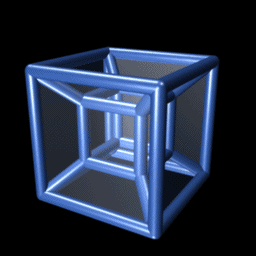
Have you ever seen or read Flatland (my favorite is the wonderful 1965 animated version, with members of Beyond the Fringe doing voices)? It's about some 2-dimensional people (squares, triangles, etc.) who meet a sphere as it passes through their space. The sphere, as it passes through, appears to grow and shrink as different parts of it are bisected by the 2-dimensional plane, and the denizens of that world think that it's only a circle which appears and disappears and fluxuates in size.
As you can see in the video above (which I found after writing most of this post), we are all multi-dimensional creatures, made huge with the vastness of time's dimension, yet seeing only the three-dimensional slice of ourselves in each moment. The younger me, the older me, the me-that-is-to-be, they are all only aspects of the wholeness of myself. So I really am only looking at a part of the whole when I wonder who that person is/was/will be.
What is the shape of that whole, really? I don't mean just in terms of our bodies moving through space; I mean, who are we? What drives us? How does that inform the multidimensional self?
Up to about twenty, we are growing so much that we can't keep up with our own changes, and as a result every time we meet ourselves we are totally different. We get used to this flux: it's all we've ever known, and we don't generally have the agency to influence the world, so we take it in stride.
However, by the twenties, then, are about being Finished -- about Being A Grownup. People in their late teens and twenties are busy reveling in doing all those things they've looked forward to doing when they became A Grownup: going out to clubs, eating whatever, drinking, staying up late, taking terrible care of their bodies: in other words, going where they want to when they want to -- and reading all those banned books. They smoke, they swear, they talk about exciting new things. They try stuff. They are busy devouring the world and showing everyone how they are Not A Kid.
In their thirties, people tend not to need to prove this point so much, and often settle down a bit, getting involved in their job or family life and generally feeling youthful but settled. Their bodies are still good, their friends are smarter, they are deepening intellectually. Life is good.
Then a weird thing happens in the forties and/or fifties. Suddenly their bodies are betraying them; weird physical anomalies appear as if overnight, literally -- one day they're not there, and the next day they are: weight gain, strange fallen bits, wrinkles and bags and puffy bits you never imagined on yourself, all materialize, one by one, in an avalanche of hellish change. By the time you're sixty or seventy, perhaps you're used to it. I don't know; I'm not there yet. However, it's clear that some people go down fighting all the way.
I used to look forward to getting crow's feet. I thought getting old wasn't such a bad thing, and looked forward to someday being one of those leathery old ladies full of cool stories (as opposed to the unmarked, unremarked face which was my youthful lot). Then one day, for reasons which aren't important but were temporary, I woke up and the space above my eyelids had fallen down over my eyes: I could feel my eyelashes holding them up, and when I looked in the mirror I almost screamed. My eyes had gone from the familiar crooked, normal-sized, expressive and not-ugly eyes to some horrid small and mean-looking ones, the eyes of a stranger. I'd swear it wasn't even me looking out of them.
In that moment, it suddenly occurred to me that this might be what my eyes might look like in old age. Suddenly I was a lot less keen. Where were my same eyes with the crow's feet? Would my eye-skin do this, simply sag over my eyes until I was drowned, lost, subsumed in someone else's face, getting up every morning and looking in the mirror and wondering where the me that I had looked at for years had gone? Was I doomed to look mean forever?
Luckily, the awful swelling passed, but it definitely shook me up.
I remember my 90-something-year-old great aunt -- the one who was married to the painter, who made amazing clothes out of curtains and wrote poetry and called you "Darling" in a wonderful deep voice -- I remember her telling my mom, "You're always sixteen inside, darling." She would flirt with young men and get away with it, because she was so dynamic. The young men always responded -- they were fascinated by her. She was as wrinkly and lacking in hair as the next old lady: but she carried herself with drama, wore interesting clothes, and was a marvelous conversationalist.
The thing is, I always aspired to be her. I thought I wanted to be that cool old lady when I was older. But I didn't realize how hard the journey might be -- to go on keeping hold of who you are when the outside of you changes so much. I'm already one of those people whose outsides and insides have never matched: I used to look in shop windows when I walked by, not because I was vain, but because I could never get used to the idea that that person was me. Initially, it was because I couldn't believe that I was fully-grown and had all the grownup bits; but later, it was more to do with not believing that the person with the blonde mane and the unfinished-looking face was really me. It simply didn't seem like an outward expression of who I was. And yet, as the years go by, you get used to that outer self and you come to see it as a favorite sweater, something comfortable that you wear every day and even dress up with accessories -- like clothes, for example (In my case, later, when I had a few more lines in my face, I dyed my hair red and became much more satisfied with the match between inner and outer selves).
Eventually, however, the sweater gets baggy -- and that's when you suddenly realize you're stuck wearing it even if you find you don't love it so much anymore.
I'm thinking more and more that what you have to do is stop thinking of it as if you are an unhappy consumer who can't buy a new sweater (although many people actually try to get the old one retailored); what you have to do is think of it -- all of it -- as a whole. It's not so much that the outer you has worn out, while the inner you is inside screaming to get out; rather, all of those incarnations of you -- the child, the nubile young thing, the virile strong young man, the parent, the middle aged person, whatever guises you have inhabited along the way -- all of those are actually still there. Literally. You just can't see them anymore.
Wikipedia informs me that although I was taught that "Time Is The Fourth Dimension," in most mathematical models there are many different spatial dimensions, and time is not a part of these dimensional spaces. However, there is a type of space (or spacetime) called Minkowski space: "In physics and mathematics, Minkowski space or Minkowski spacetime (named after the mathematician Hermann Minkowski) is the mathematical setting in which Einstein's theory of special relativity is most conveniently formulated. In this setting the three ordinary dimensions of space are combined with a single dimension of time to form a four-dimensional manifold for representing a spacetime.
"In theoretical physics, Minkowski space is often contrasted with Euclidean space. While a Euclidean space has only spacelike dimensions, a Minkowski space also has one timelike dimension." Et voila! I can still talk about time like it's a fourth dimension. Mathematicians may scoff, but it's just damned easier this way, so I'll willfully stick to it for this post.
Source: Hubblesite.org
In some version of Minkowski spacetime, then, your tired old body might look like a Nebula photo from the Hubble telescope, or like the best palimpsest you could never imagine. You might find that all the joyous moments shine among the multitudinous wholeness like stars, or that each care that etched its line on your face was represented by a thousand tiny vacillations, like the delicate frills on a jellyfish. You might find that all your many travels make you into a great creature so tangled and enfolded in the Earth that the two have become inextricable. Which gives a new meaning to the "personal responsibility" part of ecological stewardship.
Looking at the women I know who have reached the crone age successfully, I think to myself "it is possible." It's possible to move through the baggy patches with grace, building a beautiful whole. The secret is to live with joy, and the wrinkles in your 3-D self will hopefully layer themselves over the droopy eyes until the palimpsest of happiness embeds itself in your polished old skin so your eyes can't look mean, especially when you look at them in all four dimensions and see who you were, where you went, who you became, and all the many layers and scars and travels and experiences in between, becoming something so vast, so world-encompassing and beautiful that you can't help but be proud.
I've been finishing one novel and starting another, so I'm in the mode of thinking about fiction lately. I seem to be able to either write fiction or non-fiction, but not both at once. Not easily, anyway.
Below are some words of wisdom from Ursula K. LeGuin, words that make me feel much, much better, because although I write stories, I don't always write about conflict per se. Sometimes, to me, there are better things to think about, and when people tell me that to make a successful piece of fiction I need to have plot! I need to crank up the conflict! then some part of me deep inside says, "Oh, yeah?"-- and I just can't shut it up. Like the title of the book this quote comes from (Steering the Craft), I have an internal guidance system which takes me where I must go. Perhaps as a result, I do have trouble selling stories: the nice comments from genre editors I've gotten is that the story is too slow, or that not enough happens. From the occasional literary editors, what I've heard is that because the story contains speculative elements, they can't use it (though I'm much more likely to get form rejections from literary editors).
I don't mind rejections, and I'm actually pleased that I'm getting comments and personalized rejections nowadays. Believe me, it is so wonderful to be getting these nice letters now, after all the years of form rejections; however, reading these words below, especially from one of the writers I most admire, makes me want to go on trying anyway. And the words make me want to turn back against the tide of pressure I've been floating in, the one that urges plot! plot! plot! perhaps at the expense of other things: they make me want to think again about the actual words I'm using, the phrases, the intricate, tiny narratives in tiny situations that fascinate me.
I love wisdom; I love people who have gotten old enough to have this kind of perspective. I love people who are well-read and incredibly eloquent, talking about things that matter deeply to me. Steering the Craft has been a marvelous read, and these words ring, not only true, but resoundingly. __________________________
"I define story as a narrative of events (external or psychological) which moves through time or implies the passage of time, and which involves change.
"I define plot as a form of story which uses action as its mode usually in the form of conflict, and which closely and intricately connects one act to another, usually through a causal chain, ending in a climax.
"Climax is one kind of pleasure; plot is one kind of story. A strong, shapely plot is a pleasure in itself. It can be reused generation after generation. It provides an armature for narrative that beginning writers may find invaluable.
"But most serious modern fictions can’t be reduced to a plot, or retold without fatal loss except in their own words. The story is not in the plot but in the telling. It is the telling that moves.
"Modernist manuals of writing often conflate story with conflict. This reductionism reflects a culture that inflates aggression and competition while cultivating ignorance of other behavioral options. No narrative of any complexity can be built on or reduced to a single element. Conflict is one kind of behavior. There are others, equally important in any human life, such as relating, finding, losing, bearing, discovering, parting, changing.
"Change is the universal aspect of all these sources of story. Story is something moving, something happening, something or somebody changing.
"We don’t have to have the rigid structure of a plot to tell a story, but we do need a focus. What is it about? Who is it about? This focus, explicit or implicit, is the center to which all the events, characters, sayings, doings of the story originally or finally refer. It may be or may not be a simple or a single thing or person or idea. We may not be able to define it. If it’s a complex subject it probably can’t be expressed in any words at all except all the words of the story. But it is there.
"And a story equally needs what Jill Paton Walsh calls a trajectory — not necessarily an outline or synopsis to follow, but a movement to follow: the shape of a movement, whether it be straight ahead or roundabout or recurrent or eccentric, a movement which never ceases, from which no passage departs entirely or for long, and to which all passages contribute in some way. This trajectory is the shape of the story as a whole. It moves always to its end, and its end is implied in its beginning.
"Crowding and leaping have to do with the focus and the trajectory. Everything that is crowded in to enrich the story sensually, intellectually, emotionally, should be in focus — part of the central focus of the story. And every leap should be along the trajectory, following the shape and movement of the whole."
I'll leave you with that taste in your mouth, rather than even trying to reach that level of eloquence. Phew.
Also peach season, and apricot season, and many other kinds of fruit I love beyond reason.
In the winter, we collect, freeze and dry mushrooms to eat when the mushroom season has passed, so we can enjoy those flavors even when they are barely available in the fancy supermarkets for $40 a pound. We got 20 pounds of morels this year, and innumerable black trumpets. But in the summer, it's fruit. Boxes of it, bags of it: we gorge, and are content.
However, like the mushrooms I'm always trying to save that fruit for the winter months, when the flavor of blackberries or peaches can give you a moment of summer in the midst of the cold. Most years I make preserves of one sort or another. I've made strawberry jam and olallieberry jam, apple and pear butter, canned olallieberries and canned pears... yum.
The problem is, I'm almost the only one who eats it, so it sits there, fruit from summer waiting to be eaten when the fresh fruit is gone - waiting and waiting. It makes me sad. We do eat the canned olallieberries over ice cream (extra yum!)... but this year I decided to forget jam and go alcoholic.
Too much jam.
I remember when I was a kid, my parents went through a phase of making what they called "civil war nectar:" fruit in a big glass jar with sugar and something else, which fermented and produced a small amount of alcohol, which they ate over ice cream or cake. I've tried many times to get a recipe for that, but only yesterday found one:
1 part brandy 1 part fruit 1 part sugar Leave it in a covered jar for a week before using. Every time you use it, replace what you've taken with equal parts sugar and whatever fruit is in season. Refrigerate in between uses if you are not using for more than a few days. The place I found the recipe says: "Great on ice cream, pound cake, and such, but it does get very sneaky strong."
In my journeys through the internet looking for this recipe, I came instead across what seems to be a different approach to the same thing. Rumtopf ("rum pot"), also known as "tutti frutti" (all fruits, and yes, apparently that's where the name comes from) is a very old way of preserving summer flavors into the winter, from a time when alcohol was one of the only ways of preserving fruit:
"A tutti-frutti is started at the beginning of the summer, with fruits added to the mixture as they come into season. The last addition is usually made in September at the end of peach season. The trick to a successful tutti-frutti with brandy or a rumtopf with rum is to use an eclectic mixture of summer fruits, creating a blend of flavors. After the last addition, the entire mixture is set aside to mellow and age for several months. Of course, you can begin sampling the tutti-frutti/rumtopf whenever you like, but in Germany, it is not sampled until December on the first evening of advent. After that, it is fully consumed throughout the Christmas holidays. The spirited fruit is served over ice cream, pound cake, bread pudding and many other desserts. The sweet, fruity liquid can be enjoyed as an after dinner liqueur or mixed into cocktails." (Thanks to Theresa Loe)
You find a ceramic or glass jar, about a gallon in size, with a tight-fitting lid. If you don't have a lid, or if the lid doesn't fit tightly, you can supplement with plastic wrap and a rubber band. You can also put a dish inside to hold the fruit down under the alcohol.
"Strawberries, cherries, raspberries, peaches, apricots, pineapple, nectarines, red currents and plums all work well. Do not use watermelon or cantaloupe (too watery), blackberries (too seedy), bananas (too soft) or citrus (too acidic). Some people avoid dark fruits like blueberries because they will discolor the lighter fruits in the mixture..."
I actually did use blackberries, because I like their flavor, and some people do the same with blueberries. I have also heard you should not use apples or pears, because they don't have sufficient body and get all mushy. The other thing I found is that having a cylindrical jar works better with the holding-down dish, which unfortunately allows fruit to escape around the edges if you use a round jar like I have.
What thrills me about this dish is the wonderful fragrance, a summery smell that comes wafting out whenever I open the lid. I smell it, and I think about the layers of fruit inside, and how when Christmastime comes we'll appreciate that injection of lost sunshine into our lives. It's like a little pot of treasure in my pantry, waiting for me to add more anytime I get some good fruit. At some point, I will try the Civil War Nectar, but for the moment I'm looking forward to that first taste of the Rumtopf in December.
Now, the other thing I made this year, which turned out extraordinary, was Creme de Mûre, a key ingredient in one version of the French cocktail known as Kir. We learned to love this drink during the ten years our family owned an old mill in France, where we would go and stay on the river and eat French food and generally enjoy the beauty of Bourgogne (Burgundy), where the house was situated. Traditionally, kir is made with Creme de Cassis (blackcurrant), topped up with white wine from Bourgogne. It's drunk as an aperitif, before food or a snack.
"Originally called blanc-cassis, the drink is now named after Félix Kir (1876 - 1968), mayor of Dijon in Burgundy, who as a pioneer of the twinning movement in the aftermath of the Second World War popularized the drink by offering it at receptions to visiting delegations. Besides treating his international guests well, he was also promoting two vital economic products of the region." [wiki]
If the rumtopf has a wonderful scent, this one is simply godlike. I find the flavor is rich and redolent of that peculiarly spicy blackberry scent, the smell of English summers and of scratched hands, sunshine and delicious forage, stained lips and that cautious, arched straining one does to get hold of a good cluster that's just out of reach. There is nothing like the smell of good blackberries, and now by making it I've actually managed to capture that smell in a bottle. It, too, has to age for three months, so I'm really looking forward to this winter, more than any winter full of jam.
Recipe for Creme de Mûre:
500 grams of blackberries 500 ml eau de vie (I used vodka - 80 proof) 250 ml water 350 grams sugar
Crush the berries and put them in the alcohol for 24 hours (cover it well). Then strain out the fruit and put the fruit in the water for 24 hours. Strain again, putting the fruit in the compost or feeding to your chickens. Add the sugar to the blackberry-water, and heat until just warm enough to dissolve the sugar. Now mix the sugar/blackberry mixture with the alcohol. Filter it through three or four layers of cheesecloth (or a thin, open weave dishtowel -- too tightly woven and it will clog), and put in bottles. You can drink it at this point (yum), but it's apparently better if you let it age.
When my children were little, we used to read a book called Frederick, by Leo Lionni, about a mouse-poet who didn't help collect seeds and things during the summer. When the other mice complained, he said he was collecting smells and colors. Then when winter came, he was able to warm them with his words, which brought back the sights and feelings of summer in the middle of winter. I always liked this book, because it's about the things a writer wants to capture, and about bringing bits of the soft season into times that are hard and cold.
These dishes remind me of Frederick, holding tight to that fragrance and color from the season when fruit was really and truly ripe and giving it back to us again when we need it most.
So enjoy! And may your winter be full of the poetry of fruit...
The bees come and hang out with the squash blossoms and the sunflowers, and pretty much ignore the tomatoes. The bumblebees like them, though the two poor bumblebees I see in there are working hard trying to cover all those blossoms.
So I went to look up tomato pollination, and I find there is a whole mythos about tomatoes being self-pollinating. Apparently, according to this site, "The wild progenitor of our domestic tomato, in its native Peru, was pollinated by a solitary bee that was specifically adapted to it. As tomatoes were carried to other areas, its pollinator did not go with it, and pollination was often lacking."
Looking around, I came across a wonderful Instructables which explained things further:
"Tomatoes, as well as other members of the Solanaceae require a special kind of pollination to achieve proper fruit set. This form of pollination is known as "buzz pollination". Buzz pollination is accomplished by Bumblebees (Bombus), by gripping the flower with their legs and vibrating their flight muscles; honeybees (Apis) are incapable of doing this. In small gardens, bumblebee populations can be insufficient to properly pollinate tomatoes and related plants. Here's how to buzz pollinate your plants to produce larger fruits."
The 10-second video and the one-step Instructable then goes on to demonstrate a perfect (and hilarious) way to pollinate your tomatoes, which I will allow you the pleasure of discovering. It made me laugh.
Back at the first site, they tell us "Greenhouse growers for many years employed humans with electric vibrators (one brand name: Electric Bee!) to accomplish pollination. Today these have been mostly replaced with cultured bumblebees who do it more efficiently and cheaply."
All of which explains why I saw the single bumblebee in my garden, going from flower to flower and making a strange "bzazz" noise as it climbed onto each one. Yay, bumblebees! Still, I think I'll follow the Instructables and see if it helps.
Just a quick note to say I have a story coming out this fall in the new Hadley Rille anthology, The Aether Age (Helios). The book is a collaborative between the editors and the authors, set in a world where steampunk technology is developed by the ancient Egyptians, Greeks, and so on. It was really interesting and absorbing for me to write, and I'd love to do more - apparently this is only the first of several books set in the Aether Age world.
Hadley Rille Books published a story of mine in their Footprints anthology, if you recall, and I got some positive mentions for it - by people like Gardner Dozois in Locus' Year in Review, to name one. Let's hope this will do as well... though I have to say, it looks like a very cool anthology!
You can find out more about the Aether Age at the blog. I'll announce the publication date as soon as I find out about it! In the meantime, I'm very pleased about the cover art.
Okay, you-all probably already heard about this, given that the movie has already been released all over Europe, but I only found out about it this morning. After all, I've been busy building a house. Nevertheless... peel me off the ceiling!
I am absolutely over the moon. Thank you, Luc Besson!!! I have been a fan of Adele Blanc-Sec for nearly 30 years, if you can believe it: I found one of the comics in a store the very first time I went to France. It was a comic book - but it had naked breasts! And a strong woman protagonist who smoked and pulled guns on people! And it took place in the early 1900's, with all the wonderful fin de siecle architecture and early-century atmosphere! I'd never seen anything like it - the whole thing just blew my young mind. And I learned a lot of French trying to figure out what was going on.
This series of books, originally written by Jacques Tardi in 1972, is a hu-u-uge reason why I love Steampunk today. It made the most incredible impression on my young mind, and I spent many years hunting down first French, then English versions of the books. They have been hard to find, and I loved them a lot - and by extension, I learned to love Tardi. And now, thanks to the movie, Fantagraphics says they will be bringing out new English translations this fall. This sounds exciting, but it's only Volume 1 - the others will follow later (I hope).
This is a very long time coming, but I am redeemed! Bwahahaha!
Check it out:
Unfortunately, according to IMDb, the film seems to have no release dates in any English-speaking countries. It's not clear why this is, but I encourage all to write to the distribution company and demand to know when they will bring this awesome-looking film to the English-speaking world. In the UK, that would be Optimum Releasing, but I haven't found anything for North America yet. It seems like the delay in announcing it is pretty long. I just hope they're not bickering about the bath scene or something (argh).
And here are also Two reviews one of which doesn't like it so much and the other which does. I don't care - I see scenes, even in the trailer, that I remember from the book, and it makes me childishly happy, regardless!
Much apologies, although I've theoretically been back from hiatus for awhile, I've also spent some weeks sick as a dawg with a horrible lung infection. I am getting better, and as soon as I can get things back in order a bit, I'll be writing more! Promise.
Okay, I'm still on hiatus for the moment, but I just wanted to say I'll be on two panels at the Nova Albion Steampunk Exhibition in Emeryville on Saturday, March 13th. Here's the info:
Saturday 1:00-2:45 STEAMPUNK GARB FOR LIFE ON A BUDGET Jade Falcon, Ryan Galiotto, Jean Martin, Gail Carriger (M), Heather McDougal Modifying and adapting everyday wear. Making steampunk gear out of found objects and clothing.
Saturday 4:30-5:45 STEAMPUNK TECHNOLOGY Jon Sarriugarte, Patrick McKercher, Alexander Logan, Mark Anderson (M), Heather McDougal Making and creating past inventions for the future. Discussing the maker mentality, why the rise of steampunk, why now?
Yeesh! I'm terrified. But it might be fun, if I keep the Mouth Editor on full speed ahead. It's not that I'm not smart, it's that I very often don't look it, so I have to watch my step. Expect a blog post on this kind of disconnect in March.
This Hiatus was a Good Thing, and I've been collecting ideas for posts. So see you soon - I'm looking forward to it!
Things have been a little chaotic here recently. In fact, the whole summer has been nuts. I am trying to build a house (and so far failing), finishing two novels, and sorting things in order to someday move into a smaller place; we were evacuated for the Lockheed fire in August and are just getting things back in order; and suddenly, I am realizing I need to really get some writing out there now that I've been published a little bit.
So I am taking a 6-month hiatus from the blog. I don't know what that will do to my readership, but it seems more fair to simply state when I'll be back, writing about things that are cool and interesting, than to simply fall away like I've been doing recently.
I'll hopefully collect weird bits during the coming six months and come back fresh and full of new things to talk about.
In the meantime, take care and feel free to use these pages as a source of inspiration for writing or art, a place to come to be reminded that the world is not a dull place, or just resource for finding out about something obscure which just might be here.
Please, feel free to email me at mcdougal dot heather at gmail dot com and let me know if there's anything you think I should be blogging about. And thanks to those who already have. I'm thinking about it, I promise.
"Cent mille milliards de poemes" (A hundred thousand billion poems), by Raymond Queneau
For a number of years I've been really interested in the possibilities of hypertext as a vehicle for really interesting and complex narrative. I diddled around with writing stories in hypertext, but was never satisfied with the result; they seemed to me either confusing or aimless or simply mechanistic, and at best I came up with something so voluminous that I couldn't possibly complete it in one lifetime.
I decided to try poetry instead.
Poetry has the virtue of being all about simplicity, about using as few words as you can to create complex images and ideas. It's about making little windows into reality, places where the world stops for a moment and you see, really see, something unexpected.
It's really a perfect place for hypertext, being spare and clear and often having a specific structure. And there is a long history of what is called combinatorial poetry, or combinatorial text - the creation of poems that can be changed around by the reader, usually based on some mechanism in the book form. I decided that I would try haiku, since the form is so fixed. This would a) allow me to work within a specified framework, so I didn't have to also create (and get tangled up in) my own system; and b) would keep the poems from wandering off on a tangent, keeping them simple and clear. I also decided I would specify the number of links so as to keep it as structured as a traditional haiku.
What I came up with, using the simplest tools I could, was an HTML frameset system in a set window size. The top frame held the top line, the middle frame held the middle line, and the bottom frame held - well, you get the picture. Then in each line I chose one word which would be emphasized, making that the link word. When the reader clicks on that link, the line changes, creating a new haiku. (more about my process here)
It's difficult to describe it, and I can't actually insert one here in the blog, so I suggest you try one. Here's my little MetaHaiku site, where you can see a few that I've written.
The thing I like about these is that it enlarges the tiny window of a haiku without compromising its essential qualities. By nature, haiku are traditionally supposed to describe a moment, and they are supposed to contain some clue about season, and they are supposed to speak only of small things - which of course capture something much larger. So when you make a haiku with hypertext, you are creating a series of moments, a progression of snapshots which move slightly through time, describing a longer moment than a regular two-dimensional haiku. It's not so much that they describe more as that they describe longer, and the reader can unveil the moment in a way that is pleasingly exploratory.
The haiku have five links on the top line, seven on the middle, and five on the bottom, echoing the syllabic line-structure. The experience is a lot like our experience of real moments - in other words, you can't go back. There is a starting haiku and and ending haiku, and any number of ways to get there. In the present structure, you have more than 175 ways to get from the beginning to the end, so the process is surprisingly repeatable.
What I've decided is that I'd really like to share these, and see if others are interested in writing some. What I'd really like to do is to find a simple way to do it, given that mine are done in a clunky and complicated way, and then broadcast the template for everyone to use. I'm working on having a friend make a Flash interface to simplify things, but in the meantime if anyone wants to know the more lame way I did it you can email me (look in the sidebar for the address) and I'll do my best to define it for you.
Cleaning out the basement is meant to be a boring, thankless task. Fortunately for me, I seem to have been doing it for years, so now that I absolutely have to get rid of some stuff, I'm finding only the less junky stuff is really left to deal with. And so I find myself going through years of lovely stuff, things I had forgotten I own. Nice things. Things from my travels and other odd life-experiences...
George Carlin had a thing he used to do about "My stuff and your shit," but it seems to me this stuff is pretty interesting shit..
So I took some pictures.
But then, my thinking it's interesting is exactly the reason why it's in my basement.
This is one of those nesting Russian dolls, called a Matryoshka doll, but instead of those pretty girlie figures we get all the main Russian leaders, from Boris Yeltsin right back to a teeny-tiny little Ivan the Terrible.
They seem to be trying to educate us about some of the leaders, here...
Can't remember where I got these. Somewhere in Asia, during my rambles; they are opium tools, probably made for tourists, but then again, I'd bet they aren't too far off from the originals.
Glass soda bottles from a street vendor in Japan. You pay your money and the vendor bashes in the top, which is a little glass ball held in place purely by the pressure of the carbonation (see the picture below). Then you stand there and drink it, give the bottle back to the vendor, and go on your way. Needless to say, I wasn't a very good citizen, or I wouldn't have these.
The glass shell of a streetlight. Notice the interesting combination of Fresnel lens on the inner surface and wavy texture on the outside. The Fresnel lens focuses the light, and the wavy lines make it feel less like a spotlight. It's imprinted with the GE logo (see below).
A solid glass ball, about the size of a small grapefruit.
One of the few items left from my days blowing glass, probably my favorite.
Edward VIII coronation cup, horribly mended.
Everyone needs some good English stripey ceramicware!
A few of the many, many cups my father made for my wedding celebration...
...And my baby cup, also made by him.
Outside and...
...inside of a millivoltmeter, which seems to record its measurements on a soot-coated wheel marked with the hours.
A fan from a flea market in Japan. Anyone know what it says?
A very old, very beautiful, very well-loved double bridge pack of cards from the house of family in England.
And lastly, a child's toy from the same house (as are all the dolls in the bin at the top of the page).
This is only one afternoon's worth of finds. There is much more, like the things I unearthed last Friday: a set of opium weights, an opium pipe, a carving of a nasty little man from, I think, Irian Jaya (though I bought it in Kuching, on Borneo) who is clutching his penis and a knife, and who seems to have real teeth. A set of tiny old ninepins with beautiful wormholes in them. Some souvenir china from the Museum of Jurassic Technology. And on and on. I couldn't possibly put it all in my house, yet I have a hard time relinquishing it...
Life the past month has been unending chaos, so my apologies for the silence. Summer vacation starts NOW, this MINUTE - so I will work to remedy things, as soon as my head reinflates. Expect something in the next week or so, as I've had numerous posts churning around in my head for ages now!
On a (hopefully not too) prosaic note, LOOKIT my NEW TRAILER!! This is my investment in cheap travel, for the economic travails ahead. I have long loved teardrop trailers, as they are called, and this is a nice one, made by a man who creates hot rods in the Central Valley of California.
The typical teardrop is basic, just a bed and a little galley (kitchen) area, and this one is no exception, except for the extra-wideness of it and the spoke tires, apparently a sign of hot-rodness incarnate (and to be honest, not a selling point for me, though I get many admiring remarks - about the trailer - from certain kinds of men at gas stations, probably for that reason particularly).
The teardrop trailer was a phenomenon popular from the 1930s through the 1950s, an era (interrupted by a war) where the streamlining of lifestyle was a popular pursuit; the Ayn Rand vision of individual freedom and the pursuit of aesthetic practicality were in full swing, and Gernsbackian visions of shiny, teardrop-shaped futuristic vehicles were sending ripple effects throughout American culture.
My own reason for liking these trailers is more practical. Cuteness and coolness aside, I like the fact that they are still about "real" camping (well, car camping anyway) - in other words, about being outside. You live outside, you cook outside, you only go into it to sleep (which feels a bit like being in a tiny, round cabin. And we all know I love tiny spaces). But mostly, it's a practical place for your stuff to live, so you don't have to spend a lot of time packing and unpacking, setting up and taking down. I am rubbing my hands at the mere thought.
Full of plastic bins: not the cool way to go.
Now that I have a bit of time, I want to put a little work into the galley, making shelves and little spaces for storing things so they don't rattle around on the journey, and every object, like in a ship's galley, has its place. Bwahaha. It will be like a Camping Wunderkammer. I might even try a mod or two, think of ways to get it really weird and fun. Any suggestions?
Just for the sake of formality, I've got two short stories coming out in anthologies, and will be at four different related events in the coming months (who am I to turn down opportunity?):
July 18th (6-8 pm) I will be at Borderlands Books in San Francisco for my story Artifacts, which is coming out in Footprints, an anthology from Hadley Rille Books. Jay Lake, author of Mainspring and Escapement, who edited the anthology, will be there too.
Then July 20th I'll be in Berkeley at Dark Carnival, for the same story, from 6-8 pm. This will actually be the anniversary, nearly to the minute, of the 1969 Apollo 11 moon landing, the first time man ever set foot on the moon.
I believe both of these events involve some reading and signing, though I don't know how much.
At WorldCon in Montreal, I will be reading for Hadley Rille at some so-far unspecified time. Uh, signing, too, if anyone wants that.
August 29th, the Writers of the Future awards ceremony (I got second place for my story The Candy Store) is going to be an enormous bash because it is the 25th anniversary of the award. All kinds of notables are expected. I'll be there, receiving the award and signing afterwards and generally trying not to look too horrible in an evening gown thingie; and I believe they have a book signing the next day at some so-far unspecified book store, probably in Hollywood somewhere. Although it's been in Pasadena and elsewhere around L.A., so there's no knowing. I'll post it when I know.
It's all very exciting and a little scary. I only just figured out about two days ago that getting a story in an anthology actually means critics might mention the story and say bad things about it. Believe it or not, I never thought about that part of it, thinking so much about actually getting in the anthology that I didn't look that far ahead...!
A friend of mine came across this while looking up information about the late, great Edward Gorey. Apparently an early effort, and very silly, but it's fun to know that achieving greatness does not mean an author is immune to silliness. It makes one feel better, rather. It is extraordinary how many possible deflowering situations there are, including By Marimba Player, At Seance, On Cross-Country Bus, In Moroccan Palace, and many, many more.
I first learned about Mr. Gorey's works at age 12 or so when a very erudite student of my father's gave me a copy of Amphigorey. I spent a lot of time trying to puzzle out what was really going on in The Curious Sofa: A Pornographic Work by Ogdred Weary, which really only hints at being pornographic - and does contain such phrases as "well-endowed", which I didn't understand until much, much later.
My greatest regret nowadays is that I did not see the production of Edward Gorey's Dracula, with mind-boggling sets by same, in Massachussetts where I happened to be staying the summer I was sixteen. The starring role was played by Frank Langella, who did a remarkably intense Count in a heartthrob movie version of Dracula: a love story, which of course enthralled me as an adolescent. Nowadays, of course, Mr. Langella is still a very compelling and professional actor, though not quite such a sex symbol.
For the record, one of my favorite Gorey pieces at the moment (they change all the time) is The Unstrung Harp; or, Mr. Earbrass Writes a Novel, in which the unfortunate Mr. Earbrass once again goes through the horrific process of creating literature.
A sample:
"Mr Earbrass has been rashly skimming through the early chapters, which he has not looked at for months, and now sees TUH [The Unstrung Harp] for what it is. Dreadful, dreadful, DREADFUL. He must be mad to go on enduring the unexquisite agony of writing when it all turns out drivel. Mad. Why didn’t he become a spy? How does one become one? He will burn the MS. Why is there no fire? Why aren’t there the makings of one? How did he get in the unused room on the third floor?"
You can find it (expensively) in its own volume, ca. 1953; or you can find it just as pleasant to read in the first volume of the Amphigorey series of his collected works. All hail Mr. Gorey!
A few extra things:
- When I googled Mr. Earbrass, I did come across this search result, which struck me as extremely funny: Mac Forums - View Profile: Mr.Earbrass Mr.Earbrass has no contact information. Additional Information, Group Memberships. Song Recs: 0. Mr.Earbrass is not a member of any public groups ...
- Lastly, and apropo of nothing: today is the birthday of Honore Balzac. I heard on the radio he used to have a light supper and go to bed at 5 or 6 pm, then wake up at midnight and write for fifteen hours straight, subsisting on cup after cup of strong coffee. (Well, now you know, why aren't you more productive already??)