Tuesday, February 14, 2012
Shades of Old Detroit
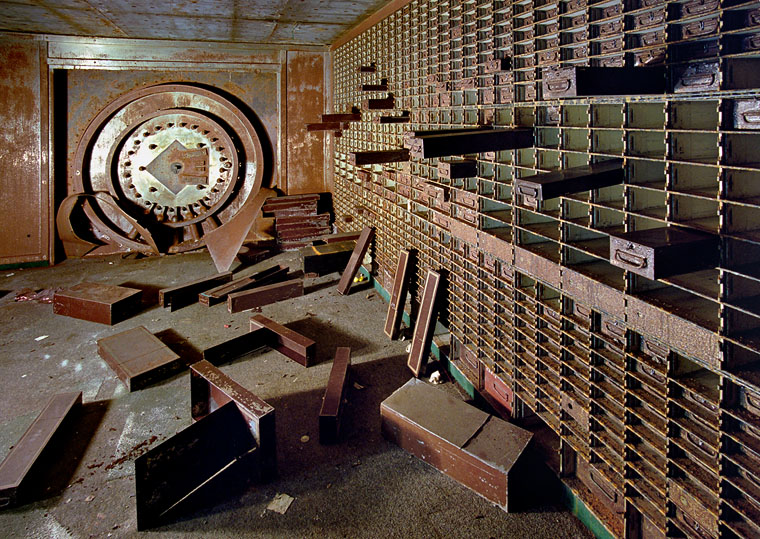
I just came across this while looking for something else in Google images: a project by Yves Marchand and Romain Meffre, called The Ruins of Detroit, a 5-year collaboration between 2005 and 2010. This is part of what they have to say about the work:
"Detroit, industrial capital of the XXth Century, played a fundamental role shaping the modern world. The logic that created the city also destroyed it. Nowadays, unlike anywhere else, the city’s ruins are not isolated details in the urban environment. They have become a natural component of the landscape. Detroit presents all archetypal buildings of an American city in a state of mummification. Its splendid decaying monuments are, no less than the Pyramids of Egypt, the Coliseum of Rome, or the Acropolis in Athens, remnants of the passing of a great Empire."
My father grew up in Detroit in the 1930s and 1940s, worked in the auto factories during the summer, and went to the grand movie houses during the height of the movie era. I have always wanted to visit the Detroit of his youth, and looking at these pictures is, in some ways, like looking at him: under the age are traces of a marvelous youth, a grace and power that still speak to us, despite the passage of time. It's both breathtaking and heartbreaking to see these remains of another era. Particularly, I find the image of the theatre to be beautiful and sad.
Wednesday, August 13, 2008
Wild Creativity: Muto, Animation on Public Walls

A friend of mine sent this link to Muto to me when I was in Croatia, but this is the first time I've actually had the bandwidth to look at it, and it's just wild. Check it out, but beware, some of it is a very tiny bit creepy-crawly, for those of you with delicate stomachs. But mostly it's just amazing.

Also, now that I'm in the land of DSL again, more posts to follow! Yay!
Sunday, June 29, 2008
San Marco Clock Tower, Venice

Ed. note: I have been meaning to post about this. Pardon my clockwork geeking below; if you are uninterested in technical details it is still worth checking out the photos!
While in Venice, I found out accidentally about the little-known tour of the beautiful clock tower on the Piazza San Marco. Everyone is so busy going into the Basilica or up the Campanile they don't look much at the clock tower; but it's a beautiful thing, marking not only the hours but the date, moon phase and astrological time.
The clock is remarkable: aside from the mechanism, there is a ball painted half gold and half blue, which by its orientation in the clock face will describe the face of the moon. A track circling the outside allows a group of four figures (the three Magi and a trumpeting angel) to pass in front of the figure of the Virgin (this only happens on two festivals a year now, see below). As they do so, the Angel raises its trumpet and its wings, and the Magi bow and move one arm in salute.

At the top of the tower, two larger-than-life shepherds (known as the Moors because of their patina) swing their hammers hourly at the great bell. They are beautifully put together (and vastly anatomically correct), their fleeces hiding the fact that they are segmented at the waist.

The clock was created by clockmaker Gian Carlo Rainieri in 1499. Rainieri then moved into the tower and was paid to keep the clock running and accurate. When he died a number of people of varying skill levels succeeded him, and after two hundred and fifty years the clock was in bad shape. So in 1752 Bartolomeo Ferracina, a reknown clockmaker, was hired to refurbish the clock.
"He actually made a completely new movement. The old mechanism and the original astronomical dial were given to him in part payment. The new movement, although modified, remains until the present day. It has four trains, in a peculiar cruciform pattern, one for the time, two for the hour strike by the Moors and one for the special 132-blow strike mechanism which will be described later. On the upper floor of the tower, above the main movement, there is a separate mechanism for the Magi's carousel." (from Antica Orologeria Famberlan, and excellent page with everything you might want to know about the mechanism's history).
Curiously, the pendulum was lengthened twice, and became long enough that it necessarily hung down into the next floor. This meant that the temperatori, living in the tower below the clock mechanism, had the pendulum moving across his living room at all times. Here is a picture from the 1950s:

The climb through the tower is "not recommended for pregnant women or people suffering from claustrophobia" as the stairs are narrow and get narrower as you go up. Personally, I was impressed with their very Enlightenment look:

In 1857 more repairs were required, and Giovanni Doria, the temperatore of the time, made a careful survey of the necessary repairs to both building and mechanism. While they were at it, the Venetians decided they wanted a luminous display on it so that the time could be read at night. So Luigi De Lucia (appropriately named) designed the two wheels that displayed lamp-lit numerals in the windows that the Magi had once come through. The light shone out through glass-covered cutouts in the metal wheels.
When I was there, I noticed a strange whirring clunk that happened every five minutes; this was the minute wheel regulator going off, and the wheel doing its turn to the next display panel. It was quite extraordinary to be privy to this mechanism, as it's very beautiful from the inside:

Note the triangular frames hanging from the ceiling. These have small, strong metal hooks on them which are hooked onto the number-wheels, allowing them to be easily disengaged and drawn backwards into the room for those days during Ascension when the Magi are once again attached to their wheel (on the floor) and allowed to parade past Mary.
There are two faces to the clock, both driven by the same movement: one of them, elaborate and decorative, faces the Doge's Palace and the Piazza San Marco, for the Doge to look at (and presumably all the Senators and so on who ran the government from the Palace). The other one was for the regular people, who lived outside the square; this one was very simple, though still elegant.

Nowadays, the clock is driven by "weights" which are actually wheels on bicycle-type chains, pulled or lifted daily by electric motors. This was based on a decision not to rely on a temperatore to pull the weights down each day and wind the movement. It is the only part of the 1750's mechanism which has been completely modernized.

I was intrigued and impressed as I followed our guide, not only because it's the kind of thing most of us dream of - living in a tower with a bunch of clockwork - but because so much of the place was designed with beauty and functionality hand-in-hand. I do love the Enlightenment and Victorian eras' penchant for lovely design! Here, for example, is the top floor, before you climb to the rooftop where the bell-ringers stand:

Or this rooftop structure which tops the spiral stairs and keeps them watertight:

I mean, really! Captain Nemo, where are you??
One of the best parts of this tour was being taken out onto the roof to see the high-Rennaissance Moors, who look about double life-size. It was so great to get up close and see the difference in their faces and poses, and understand, finally, not only how the pivot at their waists were so beautifully disguised, but to have the mechanism explained: inside their legs is a rod which turns each of them; if you look at the main clock mechanism (above) you will see a large wheel with notches in it. If you look closely, you may see that there is one notch, followed by two notches, followed by three, and so on: the wheel is actually a great cam, which moves the bell-ringers to ring the appropriate number of times.

There are two of these cams, one on each side of the clock mechanism, to drive the two Moors.
Also, if you notice there is a double cable going up to a small hammer on the edge of the bell. This was put there as part of the 1752 mechanism; at midnight every night, every blow to the bell by the Moors is relived via this little hammer: 132 blows. Whether this is a sort of "rewind" feature, or a "design feature" (or some combination of the two), I have not yet discovered.
I feel so lucky to have found this tour, which I found through an idle inquiry at the Tourist Information office at Piazza San Marco. Since then, I have tried to find the name of the place we bought our tickets, but every online source seems to try to sell them to you at great expense. It was (somewhat) cheaper in person - just enquire, as I did, and they will direct you to the nearby gallery where you can book a spot on a tour (and where there is a wonderful miniature of the tower and its mechanism). You must book it ahead of time, and show up early, as you are taken in a group over to the tower and let in the little door at the bottom (a curiously thrilling moment). When we went, it was a tour of two - my daughter and I had the place to ourselves.
I am hoping to get permission to go up in the clock in the cathedral at Strasbourg on our way through in ten days. Wish me luck!
Links:
Wikipedia, of course, has a bunch of information about the various restorations and attendant controversies.
I read the book Daughter of Venice with my daughter before going to Venice (heh), and it really put us in the mood - and filled in some details about Venetian history. It's about a girl living in 16th century Venice and is full of interesting details about what life was like for women and how families worked to keep their wealth. It describes some aspects of the governmental system of Venice and the kind of wrangling that was always going on. Great book! ...In the Young Adult section, like many good books, but readable by all ages, I think. Unfortunately, though, it doesn't discuss the clock tower in any detail.
Monday, June 9, 2008
Decrepit But Not Abandoned

It's rare, in the States, to see glass greenhouses anymore - and rarer still to see one in such a wonderful state of organic funk. I wondered what this was for ages before I went to investigate.
I found that it was the Botanički Vrt, or the Botanical Gardens, a largely futile exercise in signage, as it is crumbling and seems to have very little in the way of exotic plants. There are several greenhouses, of which this is the largest (the others seeming to be a poor storage area for a motorcycle and a bunch of cast-off window-frames). The gardens are tiny and pretty, but this greenhouse held my imagination. Walking around it was an exercise in mysterious snooping.
After I'd been there for awhile a guy came out of one of the buildings to smoke a cigarette. He looked at me curiously, then asked me a question in Croatian. After awhile I realized he had unlocked it for me, so I went inside, to a scene of curiously domestic disintegration and decay.

Proof positive that it's always worth investigating...
Friday, June 6, 2008
The Languages of Tone and Rhythm

I've always been a sucker for a good boatswain's call.
Oh, I don't mean that silly "Wee-ee-ee" you hear in Star Trek when there is a change of status; I mean the wonderful silver and copper device which was used to issue orders that could be heard above noise and weather.

There were any number of calls used to communicate different things, made by opening and closing the hand over the buoy to make the note lower or higher. Besides plain whistling, there were warbles (made by blowing jerkily) and trills (made by rolling an "r" while blowing); by blowing patterns of high and low notes of varying style, most anything that needed to be communicated on shipboard could be said.

Using flutes, whistles, and drums to communicate is a very old idea. Ancient Greek and Roman ships used flutes to help the rowers keep in step, and the boatswain's call (or bosun's whistle) has been around since at least the 1300s. Not only that, there are numerous whistling languages traditional among mountain peoples, where visual contact can be made over great distances, but the voice is difficult to discern (the exception being, of course, yodeling, which is yet another language). Some places that have developed whistling languages are Nepal, Mexico, Greece, New Guinea and the Canary Islands.
Similarly there are also drum languages, used once again to be heard over long distances (though visual connection seems to be less important here). In Africa, drum languages are so common that they are a standard and almost casual auxiliary mode of communication. In Cameroon, for example, the dogs are actually trained to recognize their names when they are drummed - which, if you think about it, isn't much different than sheepdogs recognizing their personal whistles.

Master-drummer Michel Wanga, Ippy, June 1973
There are a number of ways in which whistling or drumming can work. In some cases, they are direct transmissions of how the spoken language actually sounds. For example, the Sizang people (of Chin State, Burma) have a tonal language, so their whistled language uses an abridgement system - in other words, it drops all aspects of the language but one basic element - to mimic the tones (and then relies on context for the rest). Some languages translate the message into code - like Morse Code, for example, which bears no relation to the actual spoken message but relies on the alphabet to get a more specific kind of message across. Others use a translation system, for example, the Duala (Africa) translate their messages into such archaic synonyms that they are essentially encoding it, because the synonyms have ceased to be used in spoken language, being only retained in their drumming.
There's something about this idea, though, that is intriguing. How many of us loved the idea of a secret language when we were kids, something our friends could understand and no one else could? How many of us dreamed about smoke signals, and were fascinated by the stories of identical twins who had developed their own language which they only used with each other? There is something about the idea of being able to change forms, from words to beats or whistles, that takes this idea one step further - because you are not only speaking a language other people can't understand, you are doing it without looking like you are communicating at all. Imagine sitting in class tapping your pencil on your desk. Your teacher thinks you are simply twitchy, but in reality you are passing notes - while looking innocent and attentive.
Look at this passage from Mazateco Whistle Speech, by George M. Cowan:
"Eusebio Martinez was observed one day standing in front of his hut, whistling to a man a considerable distance away. The man was passing on the trail below, going to market to sell a load of corn leaves which he was carrying. The man answered Eusebio's whistle with a whistle. The interechange was repeated several times with different whistles. Finally the man turned around, retraced his steps a short way and came up the footpath to Eusebio's hut. Without saying a word he dumped his load on the ground. Eusebio looked the load over, went into his hut, returned with some money, and paid the man his price. The man turned and left. Not a word had been spoken. The had talked, bargained over the price, and come to an agreement satisfactory to both parties - using only whistles as a medium of communication."

In the Canary Islands, there is a shepherd's whistling language known as Silbo Gomero, or Silbo, which was extremely old (pre-Spanish) and nearly lost by the end of the 20th century. However, the Gomeran government made it mandatory for children to learn Silba in school, and it's making a comeback. There has been a lot of interest in it, even to the point of scientists doing brain scans of Silbadors (speakers of Silba) and finding that when they heard Silba their brains reacted as if they were listening to a language, as opposed to non-Silbadors, who merely responded as if they were hearing whistling. This seems a little pointless to me, since people use it to pass on fairly complex messages, despite its apparent simplicity, so it must be processed like language.
It's interesting, the question of "what is language?" Of course, if you ask different people you'll get different responses. People who study the philosophy of language tend to stroke their chins and discuss things like "What is meaning?" and "How can meaning ever really be known?" - which doesn't really answer any questions - while semioticians (who study signs, symbols, and communication) differ from linguists in that they are willing to include things other than words in their definition of language - in other words, "Semiotics differs from linguistics in that it generalizes the definition of a sign to encompass signs in any medium or sensory mode.. it... extends the definition of language in what amounts to its widest analogical or metaphorical sense." [wiki] In other words, they believe that language can exist in any number of situations and ways of expression. The language of clothes, the language of TV, the language of gestures.
Which, if you think about it, extends language into all the spheres of our thinking. We are constantly telling each other something, either through a glance, or how we hold our arms; what choose to dress that day, or whether we kiss our sweethearts goodbye. it is all communication.
I remember when I was teaching English in Japan, I used to terrify my students with the following lesson:
"Is THIS your umbrella?"
"Is this YOUR umbrella?"
"Is this your UMBRELLA?"
All of which, of course, have entirely different connotations, as they imply completely different choices that you are questioning. The first one asks which umbrella, the second asks whose umbrella, and the third, well, that one can't seem to believe it's really an umbrella at all.
So it might actually be tempting to step outside the regular context of "language" as we know it and find some simpler mode of communication. I love talking on the telephone, because I don't have to pay attention to subtle physical cues (either mine or theirs) and can rely entirely on voice timbre. I am charming on the phone, and awkward in person, because I am constantly distracted by the matter of body language: did they hear that last part? Are they bored? Did I just make them angry? ...The telephone is just so much simpler - I can funnel all that energy into my voice, and it makes me focused and comfortable.
The modern equivalent of drumming/whistling/etc. is, of course, the text message, either IM or by mobile phone. Whole languages have risen that are completely endemic to the digital environment. When older people moan that young people are being ruined by all this terrible spelling, I reply, "Not at all; they are simply learning another language." Like whistling, drumming, and smoke signals, IM and text messages use code, abridgement, phrases, and even sometimes direct transmission to get the message over a long distance. Nothing new there.

Andes, Venezuela: "at six o clock in the morning the fog was crawling over the mountains and i heard the whistle language of farmers in the valley (like you can hear on la gomera, canary islands) " (Thanks to drmidix on Flickr)
Links:
For history and how-to of the Boatswain's call, try this, this, and this. Wikipedia also has an interesting entry on it.
An odd little website on the pursuit of whistling languages (with sound samples).
BBC article on the revival of Silba.
A little page on train whistle language.
Wikipedia article on communicating through drums.
The Western Australian Maritime Museum, where you can buy a replica boatswain's call (can't guarantee the quality, though - try eBay for actual antiques)
Forms of Alternate Communication
Saturday, May 10, 2008
A Line Drawn in the Sand

Snapshot: a poor-student January weekend trip with a boyfriend to the Wine Country in Napa and Sonoma Valleys, to do some wine-tasting and try a hot spring (maybe) and just explore. Unfortunately, the wineries were largely closed and the spas were too expensive, and it rained and rained, for three days. There were flood warnings. We fell back on driving, following the Russian River out to the coast and then, eventually, on up to Mendocino. We were aimless, something I miss nowadays.
I was feeling unadventurous with the rain, so when we pulled off the road at the place where the Russian River came out to join the sea, looking out the car window at the grey day and the beach far below, I was uninclined to be friendly towards my partner when he went off down a cliff-trail to the beach below. I stood, fuming, for a little while, and then followed him down with ill-grace.
On the beach, the sounds of the sea calmed me a bit. The air was cold and fresh, and there were small birds running about. The river had formed a blind estuary:
"... “pocket” lagoons... frequently occur at the seaward end of a stream, which has a small drainage basin and thus limited amount of runoff. Where the rainfall is seasonal, the inlet of such a lagoon is open during the rainy season and is closed by wave action and long-shore drift during the dry season. Under natural conditions these lagoons have significant water exchange with the open ocean by seepage through the porous sandy barrier" [link]
The water stood, a great lake of it, bulging beyond a high sand-dune. Odd little heads peeped themselves over the edge of the dune, curious and shy, looking longingly at the sea, where another head poked out of the water: seals, trying to decide whether to make the trek over the dune to the safety of the sea.
I did what I often do at the beach, idly drawing in the sand with my heel. My friend had gone off to see if there was enough driftwood to build a little house, and looked as if he were having little success. I looked at the sand where I was scratching, and noticed something: a slow trickling of water, continuous and steady, coming out of the sand. The river, higher than the beach, was seeping through the immense sand-bank into the sea.
I walked to the top of the dune, eyeing it critically. It seemed to me that the water in the estuary was not far below the top of the dune. I decided to play around and let some trickle of the water out so that my friend and I could make dams and channels, which he was very fond of. So I dragged my heel from the water's edge over the sand-bar to the beach, making a thin scritch of a line. No way was this going to get any water. It was too far, too deep. Still, it was something to do, and sometimes I get funny about things like this. I wanted to try, anyway.
I went back and drew my heel over the line again, and again, and after four times the water's edge seemed to follow my foot a little. One last drag, and the trickle began. I had broken through!
My partner, interested in what I was doing, came over and began to help me form and shape the channel. We drew bits off to the side, made dams, played pooh sticks. Unlike most beach waterworks, the water didn't sink into the sand, but went where we bade it, forming rivulets and pools and filling dams in a most satisfactory way.
By this time the little stream had spread to be about a meter across, and a number of other people out on the beach had come over to help, digging things deeper and making better channels and dams. We had a great string of little ponds which the water leapt and bustled willingly through. Children sailed sticks down it; adult men dug furiously with sticks and hands. Everyone was sandy and wet; people shouted to one another to accomplish tasks; we all worked together to make it bigger, better, more amazing.
There came a moment when we all looked up and realized, however, that the water was now five or six meters across, and almost a meter deep in some places - and we realized that if we were to be where our cars were we would have to cross now or walk several miles back to the closest bridge. Fathers picked their kids up and hurried across the thick currents; women picked up bags and shoes and ran, splashing. We stood on opposite banks and waved at each other or stared upstream, awed.
Somehow, we were unable to leave: it was as if there was something that had not happened yet. The water grew deeper and more swift, and it became gradually clear that there was a fallen tree trunk straining above us at the sand-bank; it stirred and pushed, the water rilling around it, and we stood back, silent now, waiting, while the water pushed above and ate away below. It seemed impossible, looking at the raging torrent, deeper than a man's height now, that it had been caused by me dragging my heel across the sand.
The people on the far bank were smaller now, a good eight or ten meters away: a long "ahh" went up above the roar of the water, and the tree, moving slowly at first, began to slide along toward the sea. First it snagged, turning and rolling, and then something let go - and the tree began a stately course downstream, the brown water leaping and tugging at it. By the middle of the beach it was moving like a freight train, unstoppable, and leapt when it hit the salt water in a great arc: then, bobbing and whirling it went on, past the breaking waves and into the vast grey-blueness of the sea.
We all smiled at one another and shook our heads, trailing slowly off to our cars, turning to wave at our distant brethren. There was nothing left to stay for.
__________________________________________
"The tide rises, the tide falls,
The twilight darkens, the curlew calls;
Along the sea-sands damp and brown
The traveler hastens toward the town,
And the tide rises, the tide falls.
Darkness settles on roofs and walls,
But the sea, the sea in darkness calls;
The little waves, with their soft, white hands
Efface the footprints in the sands,
And the tide rises, the tide falls.
The morning breaks; the steeds in their stalls
Stamp and neigh, as the hostler calls;
The day returns, but nevermore
Returns the traveler to the shore.
And the tide rises, the tide falls."
- Henry Wadsworth Longfellow
__________________________________________
A year after this story, the Sonoma County Water Agency began breaching the Russian River estuary whenever it looks as if it might be causing problems upstream. However, they seem to take much more drastic measures:
"The size of the pilot channel varies depending on the height of the sandbar to be breached, the tide level, and the water surface level in the Estuary. A typical channel would be approximately 30 m long, 8 m wide, and 2 m deep (100 feet long, 25 feet wide, and 6 feet deep). The amount of sand moved can range from less than 100 cubic yards to approximately 1,000 cubic yards. The Agency contacts State Parks lifeguards within 24 hours prior to breaching activities to minimize potential hazards to beach visitors. Signs and barriers are also posted for 24 hours prior to and after breaching events to warn beach visitors of the hazards of the breaching area."

I'm sure it all starts, though, with a line drawn in the sand.
Tuesday, January 1, 2008
Bringing in the New Years' With Steam

As we walked in along the wet and muddy gravel road through the crisp darkness from where we had parked our car, the children shrieked with glee and went running ahead, toward the large grassy clearing and the little train station, now lit with Christmas lights. A large bonfire burned at the other end of the frost-covered grass, and people stood huddled around it, drinking hot cider from paper cups. In the distance the train whistle sounded, and we knew we'd arrived in time to catch the 11:00 pm run of the Swanton Pacific Railroad.
The Swanton Pacific was the child of entrepeneur and train man Al Smith, who lost a leg working for Southern Pacific, and later made his fortune parlaying the family hardware business into a successful chain which allowed him to retire and concentrate on his first love: trains. With some of his savings he bought two of the engines that were built to run the Overfair Railway, a small-scale railroad installed in San Francisco for the Panama-Pacific International Exposition of 1915: built along the lines (with improvements) of Southern Pacific's 4-6-2 Pacific type engines, they were 1/3 scale with an unusual 19-inch gauge track.
At the Expo the Overfair Railway circled the Machinery Palace (!) and went on past the San Francisco Bay, where it turned and ran along the edges of the fairground. Eighteen million people came to the Exposition, which completely -and fancifully - rebuilt parts of San Francisco, and of course, many of them rode the train. Where else could you get a ride behind a real Pacific locomotive for a dime?

The Overfair Railway, with the 1500 engine, which was built primarily to help with the building of the railway. Note the cars full of dirt (?). This 1500 engine was recently bought by Cal Poly, who are working on restoring it at their San Luis Obispo campus.
Mr. Smith, a quiet and kind man who went to Cal Poly State University to learn agriculture after he lost his leg, eventually bought 3,000 acres of land at the site of the old town of Swanton:
"...south of San Francisco and... north of Santa Cruz, inland from the Pacific Ocean, is the small community of Swanton. From 1906 to 1920, Swanton was the north end of the southern division of the Ocean Shore Railway. At Swanton, passengers boarded a 10-seat Stanley Steamer bus that filled the twenty-six-mile trackless gap between Swanton and Tunitas. Here, they again boarded a steam train to continue their trip to San Francisco. Swanton was to provide the new home for the Overfair Railway."
Being a local girl, I've heard all my life about this trip, where people got out of the train and into the steam-powered Stanley Motor Carriage bus, which took them out to the beach and then down past the cliffs at low tide, to fetch up after a wild and trackless overland ride -26 miles total - at Tunitas, where they again boarded a steam-powered train for San Francisco. The whole thing captures the imagination: the adventurousness, the wait for the tide and the wild dash across rocks and sand, all the luggage and bustle and steam at the small rural stations...

1913 Stanley Model 810 mountain wagon owned by Alan Blazick (courtesy of John Woodson's StanleySteamers.com)
Now all these are gone, even the town of Swanton; but clearly the story captured Mr. Smith's imagination, too, for he chose this spot to buy land for his railroad, and proceeded to build, with volunteer labor, a track that ran partly along the old abandoned Ocean Shore Railway right-of-way, with a station within walking distance of the old Swanton stopping-point which no longer exists (most of the town was lost in a flood in the 1950s). I'm not much of a train geek, but these engines are beautiful. They are complete down to every detail, not merely reproductions but real locomotives in a smaller scale, built by a rich perfectionist. Mr. Smith loved them. He laid several miles of track, with the aim of laying it all the way to the coastal land; but floods and Mr. Smith's death in 1993 delayed this goal, and after his death the Swanton Pacific Ranch was willed to Cal Poly, who use it for sustainable agriculture projects and, you guessed it, steam locomotion studies.
There are loads of little railways like this one tucked away across the countryside, known mostly to train people, but also open, as the Swanton Pacific Railroad is, to the public in some capacity. And if you're lucky, you'll be on the inside, around for those special events, the ones the public isn't invited to, the ones that are magic.
So every New Years' Eve, the locals and some select few train afficionados gather to talk quietly between shrieking children and laughing teenagers, to celebrate the new year and to ride the train out into the dark, under the stars. We climb into the small wooden cars and take off, away from the warmth and light of the fire and the clear glow of the tiny station, into the forest, where the steam pours out in a large cottony swath and hangs in the naked branches of the dark trees, and we all huddle under blankets and stare upward, marveling.
Links
- Images of the Exposition, very cool. I can't believe they put all this up just to take it all down again!
- One of many, many souvenir guidebooks of the Exposition - great pics of buildings that were pulled down as soon as the Expo was over, to our modern chagrin.
- Great article on the history of these engines from The Virtual Museum of San Francisco
- Article about Cal Poly's love affair with steam from the Chronicle of Higher Education
- Some rail geek pictures of the train
- Video of engine #1914 running in midsummer
Sunday, December 30, 2007
The Places We Make For Ourselves
Last time I was in France I tried desperately to get to the Palais Idéal du Facteur Cheval, but was unable to make the 5-hour trip from where I was staying - and have regretted it since. My parents have been several times, and brought back pictures and posters which I stare at every time I use their bathroom; but the actual experience, which by all accounts is surprisingly intimate and mysteriously private, is not mine to claim.
A Facteur is a postman, used like an honorific, and this "Ideal Palace" was built by one Ferdinand Cheval, starting when he was forty-three years old and finishing thirty-three years later. The inspiration for the building of this dream was an odd one:
"He tripped on a bizarre and beautiful stone in the road along his mail route and bent to pick it up. Looking about, he was surprised to see that such marvelous stones were scattered all around him, and he pocketed them to find a use for them at home. "From that moment," he says in a letter from 1897, "I did not sleep day or night." He continued his search on his daily 32 kilometer route (adding 10 km to search for more stones), first putting his treasures in his pockets, then in a wheelbarrow. He scoured the countryside for days and nights at a time on his mail route, sleeping in farmhouses and under the stars. He stock-piled the stones he brought back in his yard, which convinced his neighbors that he had gone mad, but he was determined to build the castle and grottoes that had populated his dreams 15 years earlier -- dreams he never told a soul about, fearing people would ridicule him. Cheval was a mailman by day and an architect by night, building his palace of stones and intricately carved concrete with little available light and no assistance from anyone." [from Kristin Fiore's fine website about same]
The Palais Idéal was put together from wire, lime, and cement, working by the light of an oil lamp. When they found out he wanted to be buried there with his wife, the local government protested and insisted he be buried in the consecrated cemetery; so at the age of seventy-six he began work on a mausoleum that took eight years to build; he died a year after he had finished it.
What is it that drives people to build these things, to express their creativity by building? Outsider art is a big thing these days, but for many, many years it was simply the expression of one person's eccentricity, often at the expense of their social credibility. Raw Vision, a journal of outsider art and folk art, had an article recently about the visionary environments found in the rare, vintage postcard collections of two collectors. Among others, there are postcards of the Palais Idéal, the Hotel of Old Plates in Seine Maritime, France, and Agnes Jones' Boneyard (see below). There are photos of the Shell Fence in Florida, The Living, Speaking Church of Mesnil-Gondouin, and the Mont-Cindre Hermitage in Rhone, France. A lot of the images in the article have a similar look: a complex, pebbly, "grown" look, like the dribble sand-castles we used to make when I was a child. They bear a remarkable resemblance to Gaudi's Cathedral in Barcelona.

The article begins this way:
"The rapid spread of photography from the late nineteenth century onwards meant that for the first time ordinary people could commission a visual record of themselves and their family in the same way as only the wealthy had been able to do before. The combination of this with the introduction of universal postal services and widespread railway travel resulted in photographs of every day scenes, popular figures, important events and local curiosities being printed and widely distributed as picture postcards. These postcards were produced in their millions but were some of the the earliest records of what are now termed as Outsider Art or Visionary Environments. Many of them have survived over the years and portray a variety of long lost creations with others that still exist to this day."

And so these eccentric creations get caught in time.
How long have people been driven to build such intimately bizarre masterpieces? Has this been a product of the modern world, or is it part of the human condition, that a certain number of the population must express themselves this way? America is sprinkled with the oddities that have sprung from the wild imaginings of a nation of frontierists, people insisting on being themselves because that's what "being American" is all about (traditionally): going your own way and having the freedom to express yourself, dammit! But I was impressed with the number of French visionary places, never mind that one of the collectors appears to be French, and it made me wonder.
And then, on looking into it, I find there are people like Nek Chand, who was a (surprise, surprise) a "humble transport official in the north Indian city of Chandigarh", who felt driven to clear a piece of jungle to make himself a garden, and then couldn't stop, going on to build several acres of courtyards with sculptures and walkways:
"After his normal working day Chand worked at night, in total secrecy for fear of being discovered by the authorities.When they did discover Chand's garden, local government officials were thrown into turmoil. The creation was completely illegal - a development in a forbidden area which by rights should be demolished. The outcome, however, was the enlightened decision to give Nek Chand a salary so that he could concentrate full-time on his work, plus a workforce of fifty labourers. Nek Chand's great work received immediate recognition and was inaugurated as The Rock Garden of Chandigarh."
Or, in Los Angeles, my favorite attraction - Watts Towers, the creation of Simon Rodia, about which the excellent film I Build The Tower was made. The towers are made of steel pipes and rods, around which wire mesh has been wrapped and coated with mortar, and decorated with mosaics made from broken bits of glass and pottery, as well as many found objects such as bed frames and seashells.

In 1959, "...the city of Los Angeles condemned the structure and ordered it razed. An actor, Nicholas King, and a film editor, William Cartwright, visited the site...[they] saw the neglect, and decided to buy the property for $3,000 in order to preserve it. When the city found out about the transfer, it decided to perform the demolition before the transfer went through. The towers had already become famous and there was opposition from around the world. King, Cartwright, and a curator of the Los Angeles County Museum of Art, along with area architects, artists, and community activists formed the Committee for Simon Rodia's Towers in Watts. The Committee negotiated with the city to allow for an engineering test to establish the safety of the structures.

For the test, steel cable was attached to each tower and a crane was used to exert lateral force. The crane was unable to topple or even shift the towers, and the test was concluded when the crane experienced mechanical failure." [wiki]
Agnes Jones, an ex-slave known as "Aunt Aggie", built a garden in Florida with fences, arches, and trellises made from bones wired together in fanciful ways:
"Bones bordered the white-sand walkways and formed an arcade between the front gate and the Joneses' house". There was also an informal natural history museum inside, which contained snakes preserved in jars and alligator skeletons, as well as a human skeleton hung in the hallway. No human bones were ever used in the structures, however, as Aggies was quick to explain to her visitors. Visitors are said to have loved the mixture of lush flora and sepulchral structures; "they wrote their names and addresses on the bones; children gazed on the strange beauty of the place with awe and admiration. You could buy flowers and good things to eat, have your fortune told, and hear a good story or be reminded of Aggie's favorite Bible verses".

Unlike Watts' Towers, the Boneyard was torn down in 1918 to build a high school.
And did I mention bottle houses? Or tin can houses, which are being proposed as a cheap building material (not to mention their artistic qualities)? Or how about Loy Allen Bowlin, the Rhinestone Cowboy, who made incredible interiors, exteriors, and clothes? The list goes on and on of people getting creative with their environments.

One of The Rhinestone Cowboy's interiors
I find myself thinking, reading about these fanciful places and the great sculptures, structures, doohickeys, and environments people create, and wondering how many things like this have been created - and lost - throughout history? How many of our historic and archeological discoveries are really just some eccentric's creation, lost in the sands of time? Or is it only in modern times, as the need for survival began to retreat and people had a little more leisure time, more access to materials, that people began to experiment like this?
Is it a product of mass culture, of mass-built housing and mechanized production? Or is it simply that before modernity people built what they built, and lived in it, be it eccentric or not?
Makes me want to go out and build something. There's some great rocks out back...
other links:
- Roadside America's links to Florida oddities
- Anna's Bottle House, a funky and interesting inn near Tucson, Arizona - built of bottles
Monday, November 5, 2007
Places That Are Lost

Yesterday I took a hike with my family to a waterfall that exists near where I live. Throughout my life, this place has been one of my most sacred places; even as a six- or seven-year-old I used to simply sit and admire it and the cool green pool at its base. I imagined fairies living in the mossy grottos of its rocky cliff; I saw a whole underwater world in the moving depths of the pool, where crayfish roamed under the shadows of the great rocks, and the sandy patches twinkled with fools' gold. The water fell with a sort of awesome finality down a hundred feet or so, and we would crane our necks looking at it and the trees clinging to the canyon all around.
Yesterday was the first time I had been there in nearly twenty years. There's been a flood since then, which pushed some of the great logs and large rocks around. The waterfall has worn deeper into its niche, and the shape of it has changed ever so slightly. But it's still the same canyon, the same deep pool (crayfish and fools' gold intact), the same sound and feel. The sun still slants through the trees and lights up the depths with magical fingers. It is, simply and finally, as sacred as it ever was.
There was an unnamed and unexpected comfort I gained by my visit, though, which had nothing to do with sacredness. On reflection, I think it had to do with the fact that, of all the meaningful places that existed for me in childhood, this is one of the few that still exists. There are so many, many places I have loved and lived with that are simply gone, torn down or washed away or unfindable. The barn, for example, on the ranch where I grew up: the floor and walls full of holes that we could climb in and out of; creeping around in the open space underneath its great structure; the owl pellets strewn on the floor with tiny mouse-bones and skulls in them; the wide, hand-sawn boards; the things that were stored inside.
This barn was at least a hundred feet long and thirty feet wide down the middle (not including hip roofs). It was built on two-foot-square redwood beams, sided with eighteen-inch-wide planks. It was amazing. But when the roof blew off in a freak windstorm, our landlords decided they couldn't afford to fix it. They took the whole thing down. Poof: no barn. As we used to say when my children were young (with hands held out helplessly), "All gone!"
Sometimes I wonder if I simply made up my childhood. No one seems able to corroborate it completely. There are a few photos of the barn, though.
Curiously, as these things always happen, I was already thinking about something similar before the waterfall. I had been reading BLDGBLOG, which I sometimes do, and he had a post about Gunkanjima Island, a coal-mining island off the coast of Japan that was essentially built on its own slag heap. The island had a whole town on it, of workers and their families, complete with shops and bath-houses; and the photos, taken by Japanese artist Saiga Yuji, are simply unbelievable:


I was so taken with these photos that I followed the link back to the source, Mr. Saiga's own website. Mr. Saiga, luckily, has whole portions of his site duplicated in English. I found more pictures, all beautiful and eloquent, but then I looked further - and found that Mr. Saiga had actually been there in the 1970's just before the people were due to be moved off the island, and he had taken pictures.
It is these pictures which truly caught my imagination, especially when compared with the later ones. The place is already in a state of decay, as if it was already forgotten and the people living in it were strange, living ghosts. And yet people continued to live, going to school and the bath-house, working and gossiping, running through what would soon be ruins, even while they chose what to pack for their departure. I found myself asking: how did they feel, knowing their home was already a ghost-town? What was it like, knowing they would soon leave for parts unknown, their old home crumbling to ruins behind them?

Both series are extraordinary, especially if seen backwards, with the later, abandoned images first. The photographs of hasty departure, long decayed, linger in your mind as you look at the images of people occupying the very same decay. It gives me the oddest feeling in the pit of my stomach to see the people laughing, the children playing, in what seems already to be a graveyard. It is fascinating and full of pathos.

Mr. Saiga speaks of coming to the island in the knowledge that it would soon be empty, and having one of those rare experiences with one's art where one is possessed, and must capture everything. He says:
"It was just since the previous year that I had decided to pursue photography seriously and started taking photographs. The crudeness of this series is obvious. Sentimentalism also lurks from behind. When I see the pictures now, I feel, before everything, embarrassment. But however unskillful the pictures might have been, I honestly feel that my desire to take photographs then was stronger than it is now.
I saw, at close range, islanders in pain for leaving, while I was, myself, at a loss because of the difficulty in taking photographs. I plunged myself into photography, while asking the meaning of life. In those days, photography was everything for me."

I can see why he was captivated. Places that have been lost but aren't gone have a peculiar attraction, perhaps, in my case, because of my own experience with loss of place. Pompeii, for example, or Bodie; Petra and Palmyra and Angkor Wat. Places that are both lost and gone, though, are even more mysterious, more terrible, because they live on only in the minds of the people who saw them or heard about them - or in obscure photographs which make no sense without someone to decipher them. Think of Dresden, of Ur. Memory is the only place they truly exist; memory and legend. But most lost places only leave a hole in the world for some people, and when those people are gone (an all-too simple and easy thing with our flimsy little bodies), their places will dip below the surface of history without a ripple.

It must be odd growing into an old person, watching one's world become more holes than not. I think of my rapidly-growing sense of a slipping existence, a past which exists only in my mind, and it seems like a form of insanity. I clearly see, clearly know about things and places which are patently not real. Sometimes no one else even remembers them: so are they real? Were they ever real?
I was always one of those weird people who were conscious of things going away, I don't know why. I liked to listen to old peoples' stories, because they were stories, and described things to me in ways that left traces against the things which were there for me, enriching them and informing them. But now many of those people are gone, themselves, leaving yet more holes. And their stories? I wonder sometimes if for some of them I was the only person who ever did listen.
Which is why, perhaps, I work so hard to keep my Cabinet. Like the people in Gunkanjima, I know there is not much time before I am asked to leave, so I will pack as much as I can while I wait. And save what I can of others' stuff, too.