Showing posts with label philosophy. Show all posts

Monday, November 7, 2011

Coming Home from World Fantasy


It wasn't until I was coming home that I noticed it: a sinking feeling, a sort of settling back into the greyness of my body. I had been burning, bright and smart and heard; I had been ageless, interesting, interested. I had been in the company of people who also burned with the clarity of their intelligence.

Now, on the plane, I was falling back into the usual me, flying as it were into a sort of miasma of banality, back into my age, my weight, the sense of disengagement. In other words, back to paying too much attention to other people's world-views and priorities, because they outweigh mine. It was as if I was some kind of outcast who, for a moment, had lived with her tribe, and was now going back to the other tribe, the one to whom she didn't quite belong, and whose opinions and judgements seem, in the immediate day-to-day sense, to shape the world. In fact, to shape me.

It sounds terrible, doesn't it? Sometimes a little perspective can feel like that. I found myself thinking of a story where the person has a talent -- say, the ability to save lives, or the ability to make beautiful things -- and they are brought into the place where the rich people live because of their talents; for a moment, they see how much they really shine. Then they have to go back to where they live, a place where, perhaps, the powers-that-be put something in the water, or the air, and everyone there never looks up, never shines, never thinks about anything outside their little sphere.

My father grew up in Detroit in the 1930s. I may have mentioned this before, but his family had a cottage on Lake Erie in Canada, near where my grandmother grew up. Every vacation, and even some of the school year, my father would go and stay at the cabin, where they would swim, or go ice-fishing, make things out of the clay they found along the bank. Then, inevitably, they'd come back to Detroit, over the bridge. Detroit, being a coal-fired town in those days, could not be seen from the bridge. My father says that as they came closer, you could see the steeples and the taller buildings poking up out of the dark haze that obscured the rest of the city; and as the bridge went down, they would descend into that haze, go back to Detroit life. For him, it was merely a symbol of going home.

Imagine, then, if this talented person in the story were to descend back into the place they came from, exactly like descending into the haze; but instead, it's a haze of lost ambition, disinterest in learning, provincial thinking. A sort of purgatory imposed from above, in which even the most brilliant and talented people only stand out a little through the miasma, the creative and intellectual smog. What kind of story would that make? Having been outside the smog, would the person understand, and rebel? Or would they live tragically, knowing that if they could only live in the untainted area permanently, they could be brilliant and useful and shining? Or would they understand that they might be alleviating some of the smog, challenging people's paradigms, by their very existence? I dare you to write it, and I'll write it too. Maybe we can compare notes.

In the meantime, all I can say is, hooray for the internet! May the tribes all keep in touch with each other, keep their tribeness in the best way they can.

Thursday, January 27, 2011

Why Cheap Art

If you have not seen this, you should. I have a poster of it up in my house, and have read and re-read it for years. I like it, and I'm still not tired of it. I bought it at the Cheap Art Store on Divisidero in 1989, a place that sold truly cheap art (that really was art) but didn't last that long.


'Nuff said.

Thursday, December 9, 2010

If Only I Had A Fourth-Dimensional Mirror


Since I've moved house, I've been looking through all my old clothes that have been stashed away for years. I'm one of those people who find really cool clothing and then when they look ridiculous I stash them away until they are reasonable to wear again. It's surprising how many clothes actually do work fifteen years later (as long as they're not bubble gum fashion statements).

One thing that has been striking me over and over recently is the shadow-me that I seem to live with. By this I mean, my younger self, which hangs around in these clothes and in photographs. A tall, slender girl with blonde hair who lacked the confidence to express her opinions. I pull out dresses with the 26 inch waist and think, who was that person? Why didn't she speak up? And I still feel her inside me somewhere, still anxious about things, still idealistic, and she's wondering "what the heck happened to me! I want my body back!" It's like being schizophrenic.


I think I blogged somewhere in Croatia about palimpsests, those places where the information from older times gets layered over newer information. Lately, I'm thinking that people, as creatures who live and grow through time, are really just living palimpsests. Our older selves are simply layered versions of our younger selves. Take a look, sometime, at an older person's face: you'll see every experience they ever had, etched into the lines there. If the person has had a bitter life, their face will show it; and people who live their lives well have a certain beauty, laid into their faces like a mosaic or like those poles with the layers and layers of posters stuck to them.


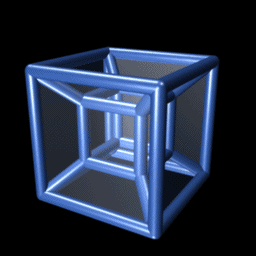
Have you ever seen or read Flatland (my favorite is the wonderful 1965 animated version, with members of Beyond the Fringe doing voices)? It's about some 2-dimensional people (squares, triangles, etc.) who meet a sphere as it passes through their space. The sphere, as it passes through, appears to grow and shrink as different parts of it are bisected by the 2-dimensional plane, and the denizens of that world think that it's only a circle which appears and disappears and fluxuates in size.


As you can see in the video above (which I found after writing most of this post), we are all multi-dimensional creatures, made huge with the vastness of time's dimension, yet seeing only the three-dimensional slice of ourselves in each moment. The younger me, the older me, the me-that-is-to-be, they are all only aspects of the wholeness of myself. So I really am only looking at a part of the whole when I wonder who that person is/was/will be.

What is the shape of that whole, really? I don't mean just in terms of our bodies moving through space; I mean, who are we? What drives us? How does that inform the multidimensional self?

Up to about twenty, we are growing so much that we can't keep up with our own changes, and as a result every time we meet ourselves we are totally different. We get used to this flux: it's all we've ever known, and we don't generally have the agency to influence the world, so we take it in stride.


However, by the twenties, then, are about being Finished -- about Being A Grownup. People in their late teens and twenties are busy reveling in doing all those things they've looked forward to doing when they became A Grownup: going out to clubs, eating whatever, drinking, staying up late, taking terrible care of their bodies: in other words, going where they want to when they want to -- and reading all those banned books. They smoke, they swear, they talk about exciting new things. They try stuff. They are busy devouring the world and showing everyone how they are Not A Kid.


In their thirties, people tend not to need to prove this point so much, and often settle down a bit, getting involved in their job or family life and generally feeling youthful but settled. Their bodies are still good, their friends are smarter, they are deepening intellectually. Life is good.

Then a weird thing happens in the forties and/or fifties. Suddenly their bodies are betraying them; weird physical anomalies appear as if overnight, literally -- one day they're not there, and the next day they are: weight gain, strange fallen bits, wrinkles and bags and puffy bits you never imagined on yourself, all materialize, one by one, in an avalanche of hellish change. By the time you're sixty or seventy, perhaps you're used to it. I don't know; I'm not there yet. However, it's clear that some people go down fighting all the way.


I used to look forward to getting crow's feet. I thought getting old wasn't such a bad thing, and looked forward to someday being one of those leathery old ladies full of cool stories (as opposed to the unmarked, unremarked face which was my youthful lot). Then one day, for reasons which aren't important but were temporary, I woke up and the space above my eyelids had fallen down over my eyes: I could feel my eyelashes holding them up, and when I looked in the mirror I almost screamed. My eyes had gone from the familiar crooked, normal-sized, expressive and not-ugly eyes to some horrid small and mean-looking ones, the eyes of a stranger. I'd swear it wasn't even me looking out of them.

In that moment, it suddenly occurred to me that this might be what my eyes might look like in old age. Suddenly I was a lot less keen. Where were my same eyes with the crow's feet? Would my eye-skin do this, simply sag over my eyes until I was drowned, lost, subsumed in someone else's face, getting up every morning and looking in the mirror and wondering where the me that I had looked at for years had gone? Was I doomed to look mean forever?

Luckily, the awful swelling passed, but it definitely shook me up.

I remember my 90-something-year-old great aunt -- the one who was married to the painter, who made amazing clothes out of curtains and wrote poetry and called you "Darling" in a wonderful deep voice -- I remember her telling my mom, "You're always sixteen inside, darling." She would flirt with young men and get away with it, because she was so dynamic. The young men always responded -- they were fascinated by her. She was as wrinkly and lacking in hair as the next old lady: but she carried herself with drama, wore interesting clothes, and was a marvelous conversationalist.

The thing is, I always aspired to be her. I thought I wanted to be that cool old lady when I was older. But I didn't realize how hard the journey might be -- to go on keeping hold of who you are when the outside of you changes so much. I'm already one of those people whose outsides and insides have never matched: I used to look in shop windows when I walked by, not because I was vain, but because I could never get used to the idea that that person was me. Initially, it was because I couldn't believe that I was fully-grown and had all the grownup bits; but later, it was more to do with not believing that the person with the blonde mane and the unfinished-looking face was really me. It simply didn't seem like an outward expression of who I was. And yet, as the years go by, you get used to that outer self and you come to see it as a favorite sweater, something comfortable that you wear every day and even dress up with accessories -- like clothes, for example (In my case, later, when I had a few more lines in my face, I dyed my hair red and became much more satisfied with the match between inner and outer selves).

Eventually, however, the sweater gets baggy -- and that's when you suddenly realize you're stuck wearing it even if you find you don't love it so much anymore.

I'm thinking more and more that what you have to do is stop thinking of it as if you are an unhappy consumer who can't buy a new sweater (although many people actually try to get the old one retailored); what you have to do is think of it -- all of it -- as a whole. It's not so much that the outer you has worn out, while the inner you is inside screaming to get out; rather, all of those incarnations of you -- the child, the nubile young thing, the virile strong young man, the parent, the middle aged person, whatever guises you have inhabited along the way -- all of those are actually still there. Literally. You just can't see them anymore.


Wikipedia informs me that although I was taught that "Time Is The Fourth Dimension," in most mathematical models there are many different spatial dimensions, and time is not a part of these dimensional spaces. However, there is a type of space (or spacetime) called Minkowski space: "In physics and mathematics, Minkowski space or Minkowski spacetime (named after the mathematician Hermann Minkowski) is the mathematical setting in which Einstein's theory of special relativity is most conveniently formulated. In this setting the three ordinary dimensions of space are combined with a single dimension of time to form a four-dimensional manifold for representing a spacetime.

"In theoretical physics, Minkowski space is often contrasted with Euclidean space. While a Euclidean space has only spacelike dimensions, a Minkowski space also has one timelike dimension."
Et voila! I can still talk about time like it's a fourth dimension. Mathematicians may scoff, but it's just damned easier this way, so I'll willfully stick to it for this post.

Hubble Captures View of
Source: Hubblesite.org
In some version of Minkowski spacetime, then, your tired old body might look like a Nebula photo from the Hubble telescope, or like the best palimpsest you could never imagine. You might find that all the joyous moments shine among the multitudinous wholeness like stars, or that each care that etched its line on your face was represented by a thousand tiny vacillations, like the delicate frills on a jellyfish. You might find that all your many travels make you into a great creature so tangled and enfolded in the Earth that the two have become inextricable. Which gives a new meaning to the "personal responsibility" part of ecological stewardship.

Looking at the women I know who have reached the crone age successfully, I think to myself "it is possible." It's possible to move through the baggy patches with grace, building a beautiful whole. The secret is to live with joy, and the wrinkles in your 3-D self will hopefully layer themselves over the droopy eyes until the palimpsest of happiness embeds itself in your polished old skin so your eyes can't look mean, especially when you look at them in all four dimensions and see who you were, where you went, who you became, and all the many layers and scars and travels and experiences in between, becoming something so vast, so world-encompassing and beautiful that you can't help but be proud.

Friday, May 15, 2009

The Muse as Moment and Place


This morning I went over to Neil Gaiman's blog to see what was up (actually, I was trying to see what his schedule was for WorldCon, but got distracted by the posts, as usual). He wrote an excellent response to a reader who was complaining about George R. R. Martin not cranking out the next book in a series.

Mr. Gaiman replies, very rightly,

"For me, I would rather read a good book, from a contented author. I don't really care what it takes to produce that.

Some writers need a while to charge their batteries, and then write their books very rapidly. Some writers write a page or so every day, rain or shine. Some writers run out of steam, and need to do whatever it is they happen to do until they're ready to write again. Sometimes writers haven't quite got the next book in a series ready in their heads, but they have something else all ready instead, so they write the thing that's ready to go, prompting cries of outrage from people who want to know why the author could possibly write Book X while the fans were waiting for Book Y."


There is much more than that, of course. But hard on the heels of my discussion of the "I Suck" moment and what to do when the writing needs a rest - and how color helps recharge those tired batteries - it made me think a little further about that process. The nice thing about Mr. Gaiman's post is that he describes the fact that writers have lives. People die, the house needs painting, or your pet needs to go to the vet. This is normal. It is easy to think of writers and artists - creative people - as being these lone madmen who drink too much, staying in their little apartment or cabin (or whatever), creating like a rabid monkey, typing or painting away to the detriment of their health and human relationships.*

This vision, of course, made me have to go find Anne Lamott's great essay about Shitty First Drafts, from her book Bird By Bird, and reread it, again:

"People tend to look at successful writers, writers who are getting their books published and maybe even doing well financially, and think that they sit down at their desks every morning feeling like a million dollars, feeling great about who they are and how much talent they have and what a great story they have to tell; that they take in a few deep breaths, push back their sleeves, roll their necks a few times to get all the cricks out, and dive in, typing fully formed passages as fast as a court reporter...

"Very few writers really know what they are doing until they've done it. Nor do they go about their business feeling dewy and thrilled. They do not type a few stiff warm-up sentences and then find themselves bounding along like huskies across the snow. One writer I know tells me that he sits down every morning and says to himself nicely, "It's not like you don't have a choice, because you do--you can either type or kill yourself."


Sometimes, I admit (much less often than BC: Before Children), I find myself bounding along like a husky through the snow. But usually it's following a long fallow period, where the ideas have been allowed to grow and mate and become fully-formed, and are now dying to get out.


So what is it that makes the muse happen? Where do the ideas come from?

I've often thought of ideas as spores. I walk around with the back of my head hanging open like a cargo plane, waiting for things to drift in. Sometimes I can feel them tickling in there when they alight, but I know by now that if I touch them at that stage they'll wilt. So I do the dishes or water the garden or drive to town, with my inner eye turned back there, peeking hopefully at the little sprouts. And eventually, some die, but some begin to get robust enough to deal with me pawing at them, examining them and even elaborating on them. Sometimes, I'll handle an idea thoroughly and then put it back into the cargo area so that other spores will land on it and change it into something beautiful. Sometimes, it meets another nice idea back there and they get together and have a happy marriage.

But they're never right in front of me. They're always in the back, or slightly to the side. They're rather slippery, and delicate, and they don't like being stared at too hard. They prefer being made concrete via my hands. If I talk about them too much, they fade; and if I get partway through making them concrete and then stop, sometimes they grow in the interim. The robust ones will poke me if I ignore them too long. The really delicate, lovely, strange ones will disappear if I don't do something about them right away, because they're too much like dreams, and don't do well in the workaday world.


In every historical discussion inspiration is seen as being, by its nature, beyond the control of the person being inspired. The Greeks, for example, saw inspiration as coming from the muses, creatures born of either Zeus and Mnemosyne (goddess of memory), or of Uranus (the Sky) and Gaia (the Earth). The muses were seen as repositories of all knowledge from the ancient age, who embodied the arts and inspired the creation process with their graces "through remembered and improvised song and stage, writing, traditional music, and dance." [wiki]

Later, the muses may have lost some of their anthropomorphic properties, but inspiration still remained outside the purview of rational, conscious thought:

"In the 18th century John Locke proposed a model of the human mind in which ideas associate or resonate with one another in the mind. In the 19th century, Romantic poets such as Coleridge and Shelley believed that inspiration came to a poet because the poet was attuned to the (divine or mystical) "winds" and because the soul of the poet was able to receive such visions. In the early 20th century, Sigmund Freud located inspiration in the inner psyche of the artist. Carl Gustav Jung's theory of inspiration suggests that an artist is one who was attuned to racial memory, which encoded the archetypes of the human mind." [wiki]

In American society, which is based more than we would like to think in the puritan, or Protestant, work ethic, the idea that something could be so uncontrollable, so beyond the reach of deadlines and time management, is unimaginable. We think that by eating right, by sleeping right, exercising, having good oral hygene, using underarm sprays and meditating, by learning to schedule play-time and carrying our watches and organizers with us everywhere, we can make sure that all the terrifying alternatives are covered and everything will go as scheduled.


Which is true of many things. But other than clearing some time so that you can clear your head, time management simply doesn't apply to inspiration. Eating, unless you're a restaurant critic, is unlikely to bring the muse. Sleeping enough might give you good, inspiring dreams; but then not sleeping enough could do the same thing. The rest of it... well, there is something to be said for the wild-man-in-the-cabin trope. At least he's not wasting valuable cargo space in the back of his head remembering music lessons and mortgage payments.


The back-to-the-land movement in the late 1960s and 1970s saw people clearing space in their lives to make room for the muse. Like the Puritans in the 1600s, the back-to-the-landers were fleeing what they saw as an oppressive society which did not let them live the life they believed in - one free of music lessons and mortgage payments. Unlike the Puritans, however, they did not believe their choices were shaping their entry into Heaven. They went to the country for much more earthly things - to grow their own food, build their own houses, and make the things they lived with. Most of the people who tried it, though, were unfamiliar with the hardships of rural living, and failed crops, leaking roofs, and lack of money to buy supplies eventually drove all but the most resourceful back to the cities.


Still, this movement planted the seeds for the voluntary simplicity movement, a more mature variation on the theme, advocating sustainable living patterns (solar power, homegrown or locally-grown organic food, and fewest possible consumerist items like credit cards and television, which eat up time and encourage spending).

"Some people practice voluntary simplicity to reduce need for purchased goods or services and, by extension, reduce their need to sell their time for money. Some will spend the extra free time helping family or others... Others may spend the extra free time to improve their quality of life, for example pursuing creative activities such as art and crafts...

"Advertising is criticised for encouraging a consumerist mentality. Many advocates of voluntary simplicity tend to agree that cutting out, or cutting down on, television viewing is a key ingredient in simple living. Some see the Internet, podcasting, community radio or pirate radio as viable alternatives." [wiki]


Unlike the desire in the 1960s to escape Baby Boom America, the new movement is a much more pragmatic desire to remake how we do things. The idea that one can take a breath and step outside the rat-race, take away all the extra parts of one's life - the things one doesn't really need but are paying for because of a perceived lifestyle definition - is not a new one. Epicurus, a philosopher of the fourth century, pointed out that troubles entailed by maintaining an extravagant lifestyle tend to outweigh the pleasure of partaking in it. Henry David Thoreau (another man in a cabin!), was famous for his desire to find a quiet place to write books, where he lived like a hermit (with weekly visits from his mother, who brought him goodies to eat).


Sometimes, though, we are simply tied to the life we have wrought. Not all of us can drop everything and go off to Walden to live alone in a cabin. Many of us have children, and must provide a place for them to live, and food for them to eat. Uprooting everything for a dream is not a simple thing. However, making time to think is not the lazy pursuit we are taught to believe. That mental space-clearing, the opening of the cargo hold and the time for the spores to take hold, is actually sacrament. Don't let anyone tell you otherwise.

Many writers and artists I've spoken to have said that giving the muse a chance to speak is their secret to productivity - in other words, making that moment every day for her to come in and then sticking to whatever comes. One man I knew, a potter, said to my father once, "I've made a deal with myself. I have to go down to the studio every day, and put my hands in the clay. Then, if I don't want to make anything, I can wash my hands and go back to the house. But usually, by the time I've gotten my hands in there, I might as well throw a pot or two." Cory Doctorow said, at Viable Paradise, that you need to make a time every day to write. You don't have to get heroic - 500 or 1,000 words each day will do - but you need to put fingers to keyboard every day. And just like my potter friend, you might find yourself writing a story or two.

Sometimes, though, like Neil Gaiman says, the house just needs to be painted. And then that's your work time, 'cause while you're watching that color spread with the roller, your brain is just going to keep collecting the spores, keep turning the ideas over and looking for worms underneath. So when you go back to the easel or the keyboard, you'll be ready.

"To have laughed often and much;
To win the respect of intelligent people and the affection of children;
To earn the appreciation of honest critics and endure the betrayal of false friends;
To appreciate beauty, to find the best in others;
To leave the world a bit better, whether by a healthy child, a garden patch, or a redeemed social condition;
To know that one life has breathed easier because you have lived;
This is to have succeeded."
- Ralph Waldo Emerson


__________________________

*Until they leave for Africa to become gun-runners.

Friday, May 1, 2009

Drunk On Color


"Imagine, if you will," he said, "that we are not in a dank and mossy crypt, but in a room of gold... that warm rays make the air softer and yellower than butter; that you breathe not this base, black, wet mist, but a sparkling bronze infusion that has been mellowed by its constant reverberation within walls of pure gold." He sucked in his breath. "The light of this room would be just that shade that we are told arises sometmes against the clouds beyond the bay, making the world gold the way it is said happens once in a... every... well... sometimes. My plan, you see," he said in pain, writhing internally, "is to build a golden room in a high place, and post watchmen to watch the clouds. When they turn gold, and the light sprays upon the city, the room will be open. The light will stuff the chamber. Then the doors will seal shut. And the goldenness will be trapped forever...

"You can bathe in the light, drink in the air, run your hands along the smooth walls. Even in the pit and trough of night, the golden room will be brightly boiling. And it will be ours."

- Mark Helprin, Winter's Tale

My writing group has a term for that period every writer goes through in phases: the "I Suck" phase, where you can't imagine anyone would ever want to read what you've written. It's difficult to get anything done during this phase because you are so self-critical; it's hard to edit things when you can't see the merit in it.

During these phases I retreat into making things. I find that a certain amount of physical creativity keeps me alive, keeps me full of interest in the world around me, and makes me more able to write. I come back to the keyboard refreshed, with new stimulus to inspire my descriptions. And my favorite kind of making things pretty much always involves the mixing, blending, and juxtaposition of color.


Knitting, for example. I must stay away from yarn stores, because the intensity of all that color makes me lose some portion of my reason, and I find myself buying hundreds of dollars worth of yarn. And, though I love knitting - capturing all that color into something I or my loved ones can wear, it's never quite as beautiful as the raw yarn. The transformation removes some random quality of the way the colors overlap and interact, and I'm left with some nice item which is merely an echo of that original glowing dream.


Similarly, the pastels section in the art store grabs me. I want to have it, to dive in it and swim through it the way Scrooge McDuck swims through his money. Color, to me, is riches. I want to surround myself with it, lay it next to itself, play in it. It is a gastronomic experience of the eyes, like eating. It has flavor and timbre; each color is a note in a riotous and elegant orchestra of beauty.


So when I make something, color is a big part of the making. But, similarly, I am caught by it in the everyday world. In the grocery store, for example, I buy tangerines when they are in season not only because I love their flavor, but because they are presented in big, shining orange heaps, sometimes with wonderfully crackly dark green leaves mixed in. And the heritage tomato booth at the Farmer's Market draws me like an addict to her dealer. Somehow, the color and the flavor become mixed in my perception so that the depth of the fragrance mingles with the richness of color and incites me to salivation, both physically and mentally.


Another place I absorb color's juicy goodness is fabric stores, especially really good stores with imported fabrics. Tweeds, especially, get me, with their subtle flecks of color; or the deep intensity of the velvets. Iridescent fabrics and deep, changing furs and the liquid brilliance of good satin. And the trim: thin strips of fluttering color to edge your sewing, bobbling tassels and piping and the thin, gauzy brilliance of translucent ribbon.


Color has always been symbolic, and very culturally driven: from the Victorian construct of the meaning of roses, to the colors people have been allowed to wear (as in the Sumptuary Laws of Elizabethan England and earlier), to the colors worn traditionally for rituals such as marriage and mourning. In Western culture, for example, black symbolizes darkness and the unknown, and death is nowadays associated with the extinguishing of light. In Asia, on the other hand, white is the color for mourning, either to symbolize enlightenment, winding-sheets, bones, the leaching of joy, or perhaps some other point of view I'm not familiar with: but interestingly, there is evidence that until recently, white was a mourning color in Western society, as well.

The sumptuary laws of Rome defined exactly who could wear the Tyrian purple dye, and how much. The Victorians believed that yellow roses symbolized jealousy (though my father gave my mother yellow roses when I was born. I doubt that was the understood symbolism between them). In America, a bride wearing a red dress would traditionally be frowned upon as a hussy; but in China, Japan, and Korea it is a traditional bridal color, symbolizing good luck and auspiciousness. And with this influence entering Western society (along with the decrease in popularity of virginal brides), the red wedding dress has become all the rage.

So the cultural definitions of the meaning of color are constantly changing. Until quite recently, men's clothing was much more on the model of male birds: the more colorful ones were more successfully showing their desirability. And less than eighty years ago, pink was considered a masculine color.


One of the greatest contributions the early Modernist painters made to art was to break with tradition, painting not in the accepted colors of nature but in the colors of feelings, of nuance, and of mood. Who, for example, has a green line down the middle of their face? Or the idea that you can sprinkle together wildly varying colors which have nothing to do with the subject at hand - and still end up with an image that is recognizable, even full of light and beauty. So perhaps my knitter's obsession with flecked yarns is not simply an addiction, but is rooted in a deeper artistic vision: that of the greater beauty of delicately trembling variety.


Everywhere I look, there is something to drink in. The seasons themselves aid me in my color addiction, changing ordinary things subtlely each month so that I cannot stop looking. The oak trees around my house, for example, are covered with a type of fast-acting moss, which interacts with water over the course of minutes to transform from dull, dry-looking brown stuff into glowing green fairy-carpet. When it rains hard, I go outside to look: I can't help it.


Big Sur, one of my favorite places to visit, is largely attractive to me because of the varied carpet of plants which grow on the roadside: sage brush, Indian paintbrush, yellow lupine, yarrow, iceplant reddened by salt, and any number of others which I can't name but which add to the mixture in rich but imperceptible ways.


Similarly, there is an ever-changing panoply of plants along the road where I live - sage, sticky monkey flower, yarrow, succulents and ferns - which has a completely different flavor, a milder, more delicate spice. And both change, depending on when you visit. Right now we are drenched in orange and blue, the color simply licking at your eyeballs, as the pastures explode with purple lupine and California poppies. When this happens, which is not quite as often as I would like - certainly not every year - I try to go and sit, at least once in the season, in the middle of one of these seas of color and just keep my eyes open until I'm full. There are so many things to see around us: the electrical fizz of the California sky against the edges of things; the phosphorescence of the right kinds of geraniums (the Mediterranean kind, not the English kind). And every country has a different light, making the colors wash over you all over again.


Cities, with their muted greys and sombre, sooty brick, hold a peculiar fascination in the romance of the grit, but after living in some very industrial cities I can truly say I don't miss the oppressive lack of color. Although in the east end of London, sometimes, the brilliant green glow of London Fields against the sooty backdrop of the rest of Hackney used to make my mood rise and my eyes dazzle.


Interestingly, the science of color tends to look the same no matter if you are coming at it from biology, computers, or painting; the structures are similar, if the specific results are different. For example, mixing colored light is what's known as additive color: you start with blackness, and add light to get a color. Mixing pigments is subtractive color - you start with a white reflective surface and add things which absorb some of the light (subtract it), changing what is reflected, in order to make color. When you mix all additive colors together (mix light together), you will end up with white; when you mix all subtractive colors together, you get... well, a dull grey - but in theory, you'll end up with black.

Computers use additive color, mixing red, green and blue to create, if not every color in the universe, then at least millions of them (which for our eyes is close enough, most of the time; the human eye can distinguish about 10 million separate colors). By adding no colors, you can get black; by adding red, green, and blue (RGB) in equal amounts, you can begin to approach white. The more of all three colors you add, the more pastel the colors.


Pigment, on the other hand, works quite differently. The traditional color wheel shows red, yellow, and blue as primaries, which, by mixing any two equally, creates the secondary colors orange, green, and violet. But as anyone who has tried mixing fire-engine red with blue can tell you, these colors in actuality don't work that well. So for color printers, the inks are actually cyan (turquoise), Magenta (pinky red), and Yellow (and black, to make things get dark, because the pigments for printers tend to be somewhat transparent and let the light through).


Our nervous system, on the other hand, "derives color by comparing the responses to light from the [three] types of cone photoreceptors in the eye [as opposed to rods, which distinguish only dark and light]. These cone photoreceptors are sensitive to different portions of the visible spectrum. For humans, the visible spectrum ranges approximately from 380 to 740 nm, and there are normally three types of cones. The visible range and number of cone types differ between species." [wiki]

Long ago, before the dinosaurs, our early fish-like ancestors had trichromatic vision (three cone receptors). For some reason, this was lost it in the time of the dinosaurs, and then later, regained by a few primates, in an act of complete Darwinian fluke. This explains why primates are the only mammals who have trichromatic vision - it is a trait mostly found in birds and reptiles (dinosaur descendents). Even then, it's mostly old-world primates who are trichromatic; for new-world monkeys, only some females (depending on individual inheritance rather than species) are trichromatic. All the males of most species, and many of the females, are dichromatic, meaning they only have two kinds of cone cells. This is because two kinds of cone designation are passed down on the X chromosome, so the males can only ever have those two, while females who have a double helping, so to speak, of cone types actually end up able to inherit all three.

Eggs: Green or Red?
For the monkeys, this has been shown to make for an evolutionary advantage, since the color-blind monkeys can't see fruit so well, and so therefore, not being distracted, tend to concentrate on other foods (such as certain kinds of leaves) which are noticeable by their shape; these foods, combined with the fruit found by the color-sighted monkeys, ensure that the group as a whole has a much broader diet than it would otherwise.

There seems to be a very interesting possibility that more cone types actually exist, because most genetic color-blindness is based on a mutation of the X chromosome's color receptor genes. In other words, they shift to a type of cone that doesn't perceive color the way it is supposed to. Theoretically, this could mean that both the monkeys and color-blind people, then, could have a type of cone which perceives something else - something which hasn't been measured.


Perhaps there is, then, some higher purpose, some evolutionary advantage, to those of us who get drunk on color. My children have a book by Leo Lionni called Frederick, about a mouse who doesn't help with the work all summer, harvesting and storing and preparing for winter. When the other mice complain, he says he is storing up all the color, the sounds and smells of the warm weather. When winter comes and all the food they have gathered is running low, he then begins to recite to them his poems, which warm the mice and fill them with the poems' evocation of flowers, sunshine, the color of fresh berries, and so on. So, in a very real sense, he was doing his work as well.

On this basis, I would like to think that my attraction to color is not merely some form of magpie consumerism, but a hoarding of beauty which I can then play back in my writing - bit by bit, during the dark times, the moments of I Suck-ness: those periods when things have gone dull and flavorless. All hail those piled-up tangerines!

Monday, January 5, 2009

Borges: Pathways of the (Postmodern) Mind


I got an email from a reader recently asking me if I knew of a story that (s)he'd read in college, and was wondering if I knew it:

"...it's a passage about taxonomy, an inventory of posessions belonging to an emperor or king. The things are themselves fantastical, but are made all the more fantastical by the ways they are grouped. The collection is divided according to rules, but not consistent rules."

I wrote back to say that I didn't immediately know the passage (s)he was talking about, but I'd ask around.

Later that night I suddenly sat up in my chair and thought, "I'll bet that was a story by Borges." It had been years and years since I read anything by him - The Library of Babel being the only one I knew of, back then - but phrases of it still came back to me now and again, out of the blue. There is a rhythm and a meter to the story which cannot be shaken, imagery which boggles and sticks; and even though I found it a very difficult story to read, I'm thinking now that it was worth it. When, fifteen years after reading it, a student of mine did a very beautiful web-design project based on that story, the memorable-ness was enhanced: her choices of excerpt, combined with extraordinary graphics which she created specifically for the project, echoed and amplified Borges' own obscure qualities. It was an extraordinary effort. I wish now I could remember that student's name.

In any case, there was something lying beneath the email's words, some quality of rhythm or description, which stirred up that part of my brain where Borges lurked. So I started Googling "Borges" and "Collection," among other things, and came up with a possibility. I wrote the person back:

There is one story by Borges called The Analytical Language of John Wilkins, which I haven't read, but seems like a fake essay. It mentions a "certain Chinese encyclopedia" that breaks things into these categories: "a) belonging to the Emperor, b) embalmed, c) tame, d) sucking pigs, e) sirens, f) fabulous, g) stray dogs, h) included in the present classification, i) frenzied, j) innumerable, k) drawn with a very fine camelhair brush, l) et cetera, m) having just broken the water pitcher, n) that from a long way off look like flies."

What a list! How fabulous! Grateful for the mind-bend, I sent the person a link to the full text.


The list continued to intrigue me, and I began to read about the piece, which does indeed appear to be an essay, written in impeccable academic style. The fact that John Wilkins and his Universal Language are real doesn't clarify exactly what the piece is, either. I was all question marks, trying to understand if it was a real essay, or a faux essay, or what? And then I came across the beginning of a serious academic article by Keith Windschuttle, adapted from his book The Killing of History: How Literary Critics and Social Theorists Are Murdering Our Past:

"MICHEL Foucault opens his book The Order of Things with a paragraph that has become one of his most famous. Foucault describes a passage from "a certain Chinese encyclopedia'' that, he claims, breaks up all the ordered surfaces of our thoughts. By "our'' thoughts, he means Western thought in the modern era. The encyclopedia divides animals into the following categories: "a) belonging to the Emperor, b) embalmed, c) tame, d) sucking pigs, e) sirens, f) fabulous, g) stray dogs, h) included in the present classification, i) frenzied, j) innumerable, k) drawn with a very fine camelhair brush, l) et cetera, m) having just broken the water pitcher, n) that from a long way off look like flies.'' Foucault writes that, thanks to "the wonderment of this taxonomy,'' we can apprehend not only "the exotic charm of another system of thought'' but also "the limitation of our own.'' What the taxonomy or form of classification reveals, says Foucault, is that "there would appear to be, then, at the other extremity of the earth we inhabit, a culture . . . that does not distribute the multiplicity of existing things into any of the categories that make it possible for us to name, speak and think.'' The stark impossibility of our thinking in this way, Foucault says, demonstrates the existence of an entirely different system of rationality."

Weird. Foucault writing about Borges as if he was dead serious, all the way through? Both Borges and Foucault are marked for their love of words and play, so it seems odd. But it got better. Mr. Windschuttle goes on to say:

"In May 1995 I gave a paper to a seminar in the Department of History at the University of Sydney, Australia. Although most of the postmodernists in the department declined to attend, they deputized one of their number, Alastair MacLachlan, to reply and, they hoped, to tear me apart. My respondent opened his remarks by citing Foucault and the Chinese taxonomy. Didn't I realize, he chided, that other cultures have such dramatically different conceptual schemes that traditional assumptions of Western historiography are inadequate for the task of understanding them?

"There is, however, a problem rarely mentioned by those who cite the Chinese taxonomy as evidence for these claims. No Chinese encyclopedia has ever described animals under the classification listed by Foucault. In fact, there is no evidence that any Chinese person has ever thought about animals in this way. The taxonomy is fictitious. It is the invention of the Argentinian short-story writer and poet Jorge Luis Borges.

"This revelation would in no way disturb the assumptions of the typical postmodernist thinker, who believes that the distinction between fact and fiction is arbitrary anyway. Foucault himself openly cites Borges as his source. The example is now so frequently cited in academic texts and debates that it is taken as a piece of credible evidence about non-Western cultures. It deserves to be seen, rather, as evidence of the degeneration of standards of argument in the Western academy."


At first glance, I was fascinated by the idea of so many academics being fooled by a supposed misquote. But then I saw: in these three paragraphs there are multiple levels of story going on. First of all, academic infighting: "they hoped to tear me apart." Then the philosophical differences between Modernists and Postmodernists, which is interesting in itself, because really, their conflict is all about ways of thinking about reality. Which is, of course what Borges' works all played with. And this man Windschuttle wrote a book about (I'm guessing here) how Postmodern thinking is destroying academic culture. And on and on, subtexts spinning off in different directions like Borges' library.


You see, this guy is clearly a modernist of the first order. Modernists, to attempt a nutshell description, are all about the importance of authorship and individual owning of ideas and works. With this, of course, come such things as credibility and provenance - in other words, knowing where you got your facts, quotes, information, etc. and making sure to list them carefully so that credit is given where it is due. Copyright is an intensely modernist concept. Postmodernists, on the other hand, are more multivocal in their viewpoint, holding that the ownership of concepts and words is less important than their relevance to culture-making; in art, for example, postmodernists will "appropriate" from anywhere and everywhere, and by redefining the context of the works or snippets, create something new (Andy Warhol's soup cans, above: using "fine art" painting methods to appropriate canned soup). In postmodern ideals, this kind of appropriation is - well, appropriate, fitting, part of the continual process we all go through of assimilating culture and creating new culture based on that assimilation. Don't forget, postmodernists believe in the virtues of play, which means you can fool around with the stuff you find around you.

So in this context, Mr. Windschuttle is complaining about postmodernists' apparently slipshod authoring (using Foucault's fictional example to define a concept under discussion), while the postmodernists themselves are busy discussing, not the provenance of the quote, but how it captures some essence of the way cultures interact (in other words, the postmodernists are acting like postmodernists). If you read Foucault's introduction, you'll find that him referring to Borges' fictional categories this way: "where could they ever meet, except in the immaterial sound of the voice pronouncing their enumeration, or on the page transcribing it? Where else could they be juxtaposed except in the non-place of language? Yet, though language can spread them before us, it can do so only in an unthinkable space." In other words, what Foucault himself is interested in is the way in which the categories exist in our minds.

Modernist thinking: hard and fast lines


It's interesting, too, how Mr. Windschuttle has so missed the boat on the discussion surrounding Foucault's piece: I seriously doubt that this discussion takes Borges' enumeration as "real," in the sense of scientific proof. From what I have seen, the discussions address the interesting issues of language and the meaningfulness of traditional categorization. Foucault's quote, curiously, is exactly applicable to the situation between Mr. Windschuttle and his postmodern rivals: he is a person from a strong cultural tradition, having trouble understanding the language of another culture's logic - in other words, trying to apprehend "a culture...that does not distribute the multiplicity of existing things into any of the categories that make it possible for us to name, speak and think." A dinosaur, some might say; but though I think it is an issue of cultural evolution, it is also a matter of vision, of the flexible apprehension of a thing which is foreign to what we have been taught. The postmodernists, in other words, think sideways to Mr. Windschuttle, and he cannot (or will not) derail his thinking in order to go where they are going.

Postmodernist thinking: playful (image courtesy of Marian Bantjes)


This problem with misapprehension is very familiar, with overtones of those people (you know who you are) who think of the Internet as a bunch of "tubes," for example. It smacks of the tendency of those older people, who use email sparingly, to condemn young peoples' desire to publicly document both the internal and external parts of their lives. No sense of shame or privacy, the older people say, too much dependence on interactive devices and formats, never allowing themselves to be alone or silent. While I agree that there is too much chatter out there, too many dead Facebook pages and dull blogs about inane activities, and in the end, not enough silence, these artifacts are nothing more than virtual paper-piles with old scribblings on them, and can be ignored. But if you take this phenomenon as a whole, you will see there is the beginning of something new, a more fractured, yet curiously wholistic, perception of the universe. A more Postmodern sensibility, if you will. Something multivocal, multivisual, multilinear. A creation of new culture based on assimilation and re-definition. Something much more like Borges' library, which:

"...consists of an endless expanse of interlocking hexagonal rooms, each of which contains...four walls of bookshelves....Though the majority of the books in this universe are pure gibberish, the library also must contain, somewhere, every coherent book ever written, or that might ever be written, and every possible permutation or slightly erroneous version of every one of those books." [wiki]

Or, perhaps, it could be something like the way the brain processes information from the eyes: we glance, and glance, and in fact move our heads around; but the brain is able to take all these fractured, moving, disjointed parts and stitch them into a coherent reality in which we live quite happily, unaware of the complexities of its creation.


The cubists were aware of this, and tried to represent "true" reality in their paintings - the reality of motion and change - by painting in glances, fragments, the bits seen in all those quick takes of the world we look at. They were breaking with the tradition of perspective, which approaches an image as if the viewer is seeing it from one, and only one, point of view. In a way, then, perspective is the less realistic of the two, given that we have binocular vision and never sit still with our head glued to a point in space. And yet, though cubism is more like how we actually use our eyes to look at things, it can present a rather nightmare vision of the world.


The difference, I think, is in the incorporation. The views we get through cubism are solely visions from the eyes, without the magical intervention of the brain; while perspective is better at fooling us, giving us a semblance of the reality our brain creates for us, which is much more comfortable and familiar.

But what if our brains began to stitch things together differently? What if, instead of either discombobulated glances or falsely cohesive systemization, we saw something which no longer hid the multiplicity of our visual intake, yet made sense of it, unfolding our sense of sight into something huge, something we could not have imagined before?


What if all the devices in our lives were to help unfold our brains into something bigger? Louder perhaps, and busier, but potently dynamic? It is no coincidence that Postmodernism and technology's multiverse have developed hand in hand, nor that the same folks who are horrified at the lack of authorial stricture tend to be the same folks who don't understand what's happening with technology. And who, perhaps, might be horrified at Borges' irreverent use of academic style to toy with our understanding of reality.

...And the reader? Well, to my great joy (s)he wrote back to say:

"Yes, yes, yes!!! I half remembered it being Magic Realism and a depiction of something Asian although I misremembered it as a collection--this is definitely it. Thank you so much...How did you find it?"

How? Hmm. Perhaps the Internet is Foucault's 'unthinkable space,' after all.

Sunday, December 16, 2007

The Unknown Museum


Years ago, my college friends and I used to take trips up to Mill Valley to visit the Unknown Museum, an amazing collection of stuff arranged in a house which looked, from the outside, like a typical Mill Valley home...except there was a bunch of stuff in the yard. Stuff like stacked TVs, bowling balls, and baby dolls transformed the outdoor space, so that walking by, you had a peep of something amazing.

Going inside on one of the few days it was open was overwhelming to the eye: an aquarium full of Mr. Potato Heads, stacks and stacks of old lunch boxes, rooms and rooms of toys, dolls, plastic bits; mannequins and glitter-balls and every kind of thing from fake food to electronic parts. Nothing seemed to be single. It all came in multiples, sometimes in the hundreds: this Museum was a Wunderkammer of post-consumer detritus. Things were not only displayed in tanks, towers, and piles but in fascinating tableaus where mannequins sat down with TV dinner trays full of vacuum tubes, or a bride-mannequin crawled across a landscape of tiny bridal figures who seem to be tying her down, Gulliver-style.

The Unknown Museum, as it was called, lived in an old radiator shop in Mill Valley from 1974 to 1985; its founder, Mickey McGowan, believes in having lots of stuff. "I always thought that if your mom threw it away, the Unknown Museum was the place to come. Once I tried to create a sort of Zen space there, a room that was spare and austere, but when I'd go in there I'd go nuts wondering what I should put in. Gor me the perfect Zen space is jammed with all kinds of stuff. Zen is all one, isn't it? Well this is all one, the purity of allness." (thanks to Image Magazine for the quote).

After twelve years, the Museum lost its lease, and Mr. McGowan moved the whole museum to the residential neighborhood that I remembered visiting, a place he felt was perfect for the Museum, having a sort of Beaver Cleaver/Ozzie Nelson flavor to it. The different rooms of the house became theme rooms: a boy's room "crammed with chemistry sets, sports equipment, war toys and insect collections; the girl's room had stacks of Nancy Drew mysteries, worn ballet shoes, jump ropes, wedding dress dolls and Katy Keene comics..."

Trapped on the way to the wedding, while everyone watches in anticipation: the landscape around the Bride is made of heaps of rice


Yet the art of the place was not simply in its sheer collecting madness, but in the way that McGowan placed everything. Nothing was overlooked. He used volumes of stuff as a kind of space-painting, creating awesome displays that overwhelmed with their numbers - but he also paid attention to theme and worked asthetically to arrange things so that they had humor and looked...well, artistic. It's rare for someone with Mr. McGowan's bent to really put so much thought and artistry into their collection of stuff, really treat it as a Wunderkammer - in how it is arranged, how it is displayed. The whole art of crafting a proper Cabinet is to be found, not only in the asthetic presentation of things, but in the personal quality of the taxonomy. So often people who love collecting tend to file their stuff away in boxes, or stack them up like Scrooge McDuck all around their room or in some kind of storage, following some external taxonomy of value or meaning; but to put it all together, to present it in a personal, whimsical, commentative style, so that people can gasp and wonder at the sheer awe of it, is really something.

And to do so with objects that most of us do not admire or feel have value is especially impressive. I would not, if you told me of this place, think that it sounded very inspiring; but the care and order of it, the gimcrack-ish depths of our own associations with what some would call junk, makes us pause, makes us wonder.

Which is the point, isn't it? Plus, making it funny is always a bonus.

The Mill Valley house was a great place, with a wonderful garden, but eventually Mr. McGowan had to move again. He put most of his stuff in storage and moved into a railway car (still decorated, of course) in Mill Valley for awhile. When I talked to him recently, he was living in a house at an undisclosed location in Marin, which he said was done up much the same as before but which he no longer opened to the public. It's a shame, because it was truly a service for people, saying to us: "Here is your unwanted, your discarded: it is your past, your childhood - and see how it can be made wonderous?"

Which is something everyone in modern consumer society needs to hear. And see.

Tuesday, October 23, 2007

Palimpsests As Metaphor

Photo courtesy of Lou


I recently came across a reference to an "architectural palimpsest", and was fascinated, not only because the term is so interesting and apt but because the way it was used could apply to so many different ideas. What a mental find! My mind went crazy with the different possibilities for a few days. What about the marks that pictures make in the places where they used to be on the walls? What about the dry spot on the ground where a car was parked during the rain?


Historically, palimpsests are parchments made of animal hide which have been scraped "clean" again so that new works can be written on them. Generally, a ghost of the original(s) remain behind the new writing, leaving traces of what once was. Sometimes, the deliberately destroyed work (parchment being more valuable than writings, at times) is the only remaining copy of an old document, and many otherwise lost works have been recovered this way.

So an architectural palimpsest is the ghostly remains of other buildings or parts of buildings that are still apparent on existing buildings. And, it turns out, there are tons of other kinds of extended uses of the term. The art and philosophy worlds are, of course chockablock with them. Archeologists extend the idea of architectural palimpsest into their own study of layered structures, to mean "accumulated iterations of a design or a site, whether in literal layers of archaeological remains, or by the figurative accumulation and reinforcement of design ideas over time." It is a good word for structures or traces which have obviously morphed over time but which defy specific dating.

Photo link


The term is also used by forensic scientists to describe how objects at a site are layered on top of one another, showing the order of events. That in itself is fascinating. Forensic science can be incredibly dull, but in its basic form - the study of the laying-out of objects to see what happened to make them fall that way - it reeks not only of Sherlock Holmes, but of Miss Haversham, that perfect example of creepy time-stoppage.

In more theoretical discourse, palimpsests appear in relation to psychology, culture, and even mythology. Baudriard, that inimical but required author we had to slog through in graduate school, discusses the way modern culture is simply a layered miasma of images of images of images - a totally mediated experience - until we no longer know where or what the original once was. Myths and rituals get worked over by time and human creativity until the originals show through only in glimmers; fairy tales gain and lose characters, nastiness, and motif depending on the era in which we live. Our whole existence could be seen as a long progression of palimpsestic reality, where the old cultures, the old ways, are stripped away but continue to shine through in the ways we do things: our superstitions, our celebrations.

Photo courtesy of Lou


Historians are, in fact, beginning to use the word more and more, not only to describe revisionist histories and how they never work, but to describe history as a whole, in the way people experience time. We all, in fact, wake up every morning with the memory of yesterday all ready-scraped for us to write the new day on. Our whole experience of the world could be said to be like a palimpsest. I could go on and on - it is a lovely metaphor.

And what about technology? My friend Gwyan is interested in virtual ruins, the remains of old websites that linger around the internet, out-of-date and unused. They are archeological artifacts, echos of earlier information which have not yet faded. To some extent hypertext itself is a bit like a renewable palimpsest...or hard drives! Now that's what I call a palimpsest. And, in a cyberpunk future of endlessly re-used technological junk, can't you see old circuitry being re-fitted and re-programmed for new uses by junk-diving scavengers? Talk about re-use. You never know, I might be talking about reality for us all, in the future. The gods we know now and in the known past could be replaced by scraped-over versions at any time.

Sometimes, I get a fleeting glimpse of an idea, and long to make it real. I wonder, in fiction writing, if it might be worth literally creating a type of palimpsest for world-building. What if a writer wrote stories about other stories about other stories, and then used that as a jumping-off point for the real story? Wouldn't the end result be deeply enriched? Wouldn't that writer's built world then take on the patina of a real, true place with actual thickness, rather than that of a stage set or a newly-built suburb? This does happen, to some extent, with fan fiction and with writers who write about the same world throughout their lives. But I'd like to try it as a really disciplined experiment, a rigorous exercise, a buildup of reality for the history of my world.

Ah, well, maybe in that other lifetime I keep saying I'll live. If only we could write over ourselves and live many, many times, with the old self showing through...oh, sorry, I forgot: they do that in India, don't they?