Thursday, December 9, 2010

If Only I Had A Fourth-Dimensional Mirror


Since I've moved house, I've been looking through all my old clothes that have been stashed away for years. I'm one of those people who find really cool clothing and then when they look ridiculous I stash them away until they are reasonable to wear again. It's surprising how many clothes actually do work fifteen years later (as long as they're not bubble gum fashion statements).

One thing that has been striking me over and over recently is the shadow-me that I seem to live with. By this I mean, my younger self, which hangs around in these clothes and in photographs. A tall, slender girl with blonde hair who lacked the confidence to express her opinions. I pull out dresses with the 26 inch waist and think, who was that person? Why didn't she speak up? And I still feel her inside me somewhere, still anxious about things, still idealistic, and she's wondering "what the heck happened to me! I want my body back!" It's like being schizophrenic.


I think I blogged somewhere in Croatia about palimpsests, those places where the information from older times gets layered over newer information. Lately, I'm thinking that people, as creatures who live and grow through time, are really just living palimpsests. Our older selves are simply layered versions of our younger selves. Take a look, sometime, at an older person's face: you'll see every experience they ever had, etched into the lines there. If the person has had a bitter life, their face will show it; and people who live their lives well have a certain beauty, laid into their faces like a mosaic or like those poles with the layers and layers of posters stuck to them.


Have you ever seen or read Flatland (my favorite is the wonderful 1965 animated version, with members of Beyond the Fringe doing voices)? It's about some 2-dimensional people (squares, triangles, etc.) who meet a sphere as it passes through their space. The sphere, as it passes through, appears to grow and shrink as different parts of it are bisected by the 2-dimensional plane, and the denizens of that world think that it's only a circle which appears and disappears and fluxuates in size.


As you can see in the video above (which I found after writing most of this post), we are all multi-dimensional creatures, made huge with the vastness of time's dimension, yet seeing only the three-dimensional slice of ourselves in each moment. The younger me, the older me, the me-that-is-to-be, they are all only aspects of the wholeness of myself. So I really am only looking at a part of the whole when I wonder who that person is/was/will be.

What is the shape of that whole, really? I don't mean just in terms of our bodies moving through space; I mean, who are we? What drives us? How does that inform the multidimensional self?

Up to about twenty, we are growing so much that we can't keep up with our own changes, and as a result every time we meet ourselves we are totally different. We get used to this flux: it's all we've ever known, and we don't generally have the agency to influence the world, so we take it in stride.


However, by the twenties, then, are about being Finished -- about Being A Grownup. People in their late teens and twenties are busy reveling in doing all those things they've looked forward to doing when they became A Grownup: going out to clubs, eating whatever, drinking, staying up late, taking terrible care of their bodies: in other words, going where they want to when they want to -- and reading all those banned books. They smoke, they swear, they talk about exciting new things. They try stuff. They are busy devouring the world and showing everyone how they are Not A Kid.


In their thirties, people tend not to need to prove this point so much, and often settle down a bit, getting involved in their job or family life and generally feeling youthful but settled. Their bodies are still good, their friends are smarter, they are deepening intellectually. Life is good.

Then a weird thing happens in the forties and/or fifties. Suddenly their bodies are betraying them; weird physical anomalies appear as if overnight, literally -- one day they're not there, and the next day they are: weight gain, strange fallen bits, wrinkles and bags and puffy bits you never imagined on yourself, all materialize, one by one, in an avalanche of hellish change. By the time you're sixty or seventy, perhaps you're used to it. I don't know; I'm not there yet. However, it's clear that some people go down fighting all the way.


I used to look forward to getting crow's feet. I thought getting old wasn't such a bad thing, and looked forward to someday being one of those leathery old ladies full of cool stories (as opposed to the unmarked, unremarked face which was my youthful lot). Then one day, for reasons which aren't important but were temporary, I woke up and the space above my eyelids had fallen down over my eyes: I could feel my eyelashes holding them up, and when I looked in the mirror I almost screamed. My eyes had gone from the familiar crooked, normal-sized, expressive and not-ugly eyes to some horrid small and mean-looking ones, the eyes of a stranger. I'd swear it wasn't even me looking out of them.

In that moment, it suddenly occurred to me that this might be what my eyes might look like in old age. Suddenly I was a lot less keen. Where were my same eyes with the crow's feet? Would my eye-skin do this, simply sag over my eyes until I was drowned, lost, subsumed in someone else's face, getting up every morning and looking in the mirror and wondering where the me that I had looked at for years had gone? Was I doomed to look mean forever?

Luckily, the awful swelling passed, but it definitely shook me up.

I remember my 90-something-year-old great aunt -- the one who was married to the painter, who made amazing clothes out of curtains and wrote poetry and called you "Darling" in a wonderful deep voice -- I remember her telling my mom, "You're always sixteen inside, darling." She would flirt with young men and get away with it, because she was so dynamic. The young men always responded -- they were fascinated by her. She was as wrinkly and lacking in hair as the next old lady: but she carried herself with drama, wore interesting clothes, and was a marvelous conversationalist.

The thing is, I always aspired to be her. I thought I wanted to be that cool old lady when I was older. But I didn't realize how hard the journey might be -- to go on keeping hold of who you are when the outside of you changes so much. I'm already one of those people whose outsides and insides have never matched: I used to look in shop windows when I walked by, not because I was vain, but because I could never get used to the idea that that person was me. Initially, it was because I couldn't believe that I was fully-grown and had all the grownup bits; but later, it was more to do with not believing that the person with the blonde mane and the unfinished-looking face was really me. It simply didn't seem like an outward expression of who I was. And yet, as the years go by, you get used to that outer self and you come to see it as a favorite sweater, something comfortable that you wear every day and even dress up with accessories -- like clothes, for example (In my case, later, when I had a few more lines in my face, I dyed my hair red and became much more satisfied with the match between inner and outer selves).

Eventually, however, the sweater gets baggy -- and that's when you suddenly realize you're stuck wearing it even if you find you don't love it so much anymore.

I'm thinking more and more that what you have to do is stop thinking of it as if you are an unhappy consumer who can't buy a new sweater (although many people actually try to get the old one retailored); what you have to do is think of it -- all of it -- as a whole. It's not so much that the outer you has worn out, while the inner you is inside screaming to get out; rather, all of those incarnations of you -- the child, the nubile young thing, the virile strong young man, the parent, the middle aged person, whatever guises you have inhabited along the way -- all of those are actually still there. Literally. You just can't see them anymore.
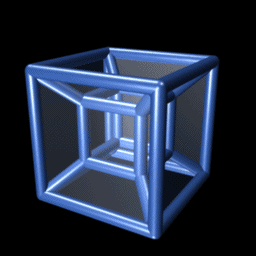

Wikipedia informs me that although I was taught that "Time Is The Fourth Dimension," in most mathematical models there are many different spatial dimensions, and time is not a part of these dimensional spaces. However, there is a type of space (or spacetime) called Minkowski space: "In physics and mathematics, Minkowski space or Minkowski spacetime (named after the mathematician Hermann Minkowski) is the mathematical setting in which Einstein's theory of special relativity is most conveniently formulated. In this setting the three ordinary dimensions of space are combined with a single dimension of time to form a four-dimensional manifold for representing a spacetime.

"In theoretical physics, Minkowski space is often contrasted with Euclidean space. While a Euclidean space has only spacelike dimensions, a Minkowski space also has one timelike dimension."
Et voila! I can still talk about time like it's a fourth dimension. Mathematicians may scoff, but it's just damned easier this way, so I'll willfully stick to it for this post.

Hubble Captures View of
Source: Hubblesite.org
In some version of Minkowski spacetime, then, your tired old body might look like a Nebula photo from the Hubble telescope, or like the best palimpsest you could never imagine. You might find that all the joyous moments shine among the multitudinous wholeness like stars, or that each care that etched its line on your face was represented by a thousand tiny vacillations, like the delicate frills on a jellyfish. You might find that all your many travels make you into a great creature so tangled and enfolded in the Earth that the two have become inextricable. Which gives a new meaning to the "personal responsibility" part of ecological stewardship.

Looking at the women I know who have reached the crone age successfully, I think to myself "it is possible." It's possible to move through the baggy patches with grace, building a beautiful whole. The secret is to live with joy, and the wrinkles in your 3-D self will hopefully layer themselves over the droopy eyes until the palimpsest of happiness embeds itself in your polished old skin so your eyes can't look mean, especially when you look at them in all four dimensions and see who you were, where you went, who you became, and all the many layers and scars and travels and experiences in between, becoming something so vast, so world-encompassing and beautiful that you can't help but be proud.

Wednesday, December 1, 2010

This Is a Blog Post About News Websites

I don't usually do this simple passing-on-of-the-link, but I had to share.

Someone just sent me this link to a non-article about science writing, and it makes me laugh. It's hard to explain why it's so funny, but if you read as many website science articles that sum up what someone else said about the science, you'll probably think it's funny too. Especially as the Guardian themselves are known to write articles almost exactly like this...

Thursday, November 25, 2010

Of Whales and Tourism and Ill Luck

Disclaimer: Not my whale, just an amazing photo

A few days ago a blue whale washed up on a beach near where I live. We went to see her, all 86 feet of her; she lay in the sand of a little cove, upside down, with the great pleats underneath exposed to the world. Nearby lay the unfinished foetus which had been killed when its mother hemorrhaged after being hit by a freighter. Scientists from the marine lab had taken her pelvis, and removed the foetus (I assume) as part of their measuring.


It was quite a stunning thing to behold. It looked almost unreal, like something made from plastic for a Hollywood movie. It was really hard to believe it was something which had been truly real and alive, swimming in the sea a few days or weeks before. The sand was soaked with whale-oil, and everyone who walked in it had to throw away their shoes afterwards, because the smell was literally impossible to remove. A local woman told me a blue whale had washed up fifty years ago and they had tried to move it with a giant lumber forklift; she said even twenty, twenty-five years ago the thing had still smelled. They'd been unable to ever completely remove it from the machinery.

Which makes sense; whale oil was one of the key original ingredients of Rust-Oleum protective anti-rust paint. If it takes 30 years to get the whale oil off a forklift, it must have been a mighty good anti-rust material. It is apparently a kind of liquid wax, and not a true oil at all (although the line between oil and wax is a very subtle one).

Whale oil is, of course, why most whales were killed in the seventeenth through the nineteenth centuries. Not only any old whale oil was useful but in particular sperm oil, from the head of the sperm whale, which contains spermaceti, "brilliant white crystals that are hard but oily to the touch, and are devoid of taste or smell, making it very useful as an ingredient in cosmetics, leatherworking, and lubricants." [wiki] Sperm whales also produce ambergris, a very special and mysterious substance which the whales secret in their stomachs to ease the passage of hard objects (like giant squid beaks):

"Ambergris has been mostly known for its use in creating perfume and fragrance much like musk. While perfumes can still be found with ambergris around the world, ...It was banned from use in many countries in the 1970s, including the United States, because its precursor originates from the sperm whale, which is an endangered species. However it has been legal since 2005 due to strict monitoring of distributors who ensure that only ambergris that has been naturally washed to shore is sold. Ancient Egyptians burned ambergris as incense ...The ancient Chinese called the substance 'dragon's spittle fragrance.' During the Black Death in Europe, people believed that carrying a ball of ambergris could help prevent them from getting the plague. This was because the fragrance covered the smell of the air which was believed to be the cause of plague ... some people consider it an aphrodisiac. During the Middle Ages, Europeans used ambergris as a medication for headaches, colds, epilepsy, and other ailments." [wiki]

The thing that struck me most was the feeling, looking at all the people who came out to see the whale, that nothing had changed: take away the jeans and sneakers, and you had an image straight out of an old engraving of the tourists going to see the giant beached sea beast. Compare these two images, if you will:


The lower one, of course, being my whale (thanks to Biblioddysey for the upper one).

There were some chunks of baleen (filtering teeth which the whale uses to catch krill) nearby, removed or broken out for I'm not sure what purpose. I took some pictures of them, once again impressed by how much of what had grown naturally seemed like something built, something incredibly engineered. The texture of the baleen was hard and resin-like, but ultimately fibrous, and the inner texture was sort of shredded into a hairy finish. The efficiency of this structure is extraordinary: the hard, slotted part lets the water out very quickly and the hairy inner part keeps in all the little food animals.


Whales are extraordinary creatures. Their sheer size is extraordinary, of course, but the way they have adapted, the incredible complexity of their biology -- the substances they produce, the structures of their bodies, even the way they interact, are all unique and difficult for us to really grasp, since they live in such a different environment from us. The mystique of whales is long-established, even when the tradition was to kill them if you could -- as you can see by any light reading of Moby Dick. Did you know, for example, that one newborn blue whale drinks one hundred gallons of milk a day, and by the time they are weaned weigh around twenty-three tons? Or that one blue whale can hear another's song across thousands of miles of ocean?


Sometimes, for whatever reason, they come up out of the sea to die, and we don't know why. People make extraordinary efforts to help whales who have beached themselves, sometimes in large groups. There are a number of engravings depicting the fascination people have with whales which have come up on the beach...


(Particularly, if you look closely, these people seem fascinated with the size of their penises).

Unfortunately, while there is a ban on whaling nowadays, many peoples don't go along with it. The biggest offenders (though there are several) in this controversy are the Japanese, who continue to whale for "science" in rather stunning numbers and whose whale meat seems to find its way into all kinds of lucrative places, under the noses of the regulatory bodies who try to keep track of these things.


When I was a little kid, I remember people making fun, not of tree-huggers, but of people who supposedly went around with signs saying "Save the Whales." At the time, it seemed that the ocean's vastness was inexhaustable, and most people rolled their eyes at the way those animal-loving people talked about whale songs and the beauty of the pods moving through the water. But now, in the present climate of loss and depletion, these stories become more meaningful. Anyone who has been out in a boat and seen whales up close will attest: they are beautiful. The fact that such isolated creatures continue to talk to one another over great distances is amazing. Within their very bodies, they produce magical substances -- and structures -- which vie with some of our highest technology.

And their sheer size and power is, of course, staggering.

Monday, November 22, 2010

Ursula LeGuin: The Conflict and The Plot

I've been finishing one novel and starting another, so I'm in the mode of thinking about fiction lately. I seem to be able to either write fiction or non-fiction, but not both at once. Not easily, anyway.

Below are some words of wisdom from Ursula K. LeGuin, words that make me feel much, much better, because although I write stories, I don't always write about conflict per se. Sometimes, to me, there are better things to think about, and when people tell me that to make a successful piece of fiction I need to have plot! I need to crank up the conflict! then some part of me deep inside says, "Oh, yeah?"-- and I just can't shut it up. Like the title of the book this quote comes from (Steering the Craft), I have an internal guidance system which takes me where I must go. Perhaps as a result, I do have trouble selling stories: the nice comments from genre editors I've gotten is that the story is too slow, or that not enough happens. From the occasional literary editors, what I've heard is that because the story contains speculative elements, they can't use it (though I'm much more likely to get form rejections from literary editors).

I don't mind rejections, and I'm actually pleased that I'm getting comments and personalized rejections nowadays. Believe me, it is so wonderful to be getting these nice letters now, after all the years of form rejections; however, reading these words below, especially from one of the writers I most admire, makes me want to go on trying anyway. And the words make me want to turn back against the tide of pressure I've been floating in, the one that urges plot! plot! plot! perhaps at the expense of other things: they make me want to think again about the actual words I'm using, the phrases, the intricate, tiny narratives in tiny situations that fascinate me.

I love wisdom; I love people who have gotten old enough to have this kind of perspective. I love people who are well-read and incredibly eloquent, talking about things that matter deeply to me. Steering the Craft has been a marvelous read, and these words ring, not only true, but resoundingly.
__________________________

"I define story as a narrative of events (external or psychological) which moves through time or implies the passage of time, and which involves change.

"I define plot as a form of story which uses action as its mode usually in the form of conflict, and which closely and intricately connects one act to another, usually through a causal chain, ending in a climax.

"Climax is one kind of pleasure; plot is one kind of story. A strong, shapely plot is a pleasure in itself. It can be reused generation after generation. It provides an armature for narrative that beginning writers may find invaluable.

"But most serious modern fictions can’t be reduced to a plot, or retold without fatal loss except in their own words. The story is not in the plot but in the telling. It is the telling that moves.

"Modernist manuals of writing often conflate story with conflict. This reductionism reflects a culture that inflates aggression and competition while cultivating ignorance of other behavioral options. No narrative of any complexity can be built on or reduced to a single element. Conflict is one kind of behavior. There are others, equally important in any human life, such as relating, finding, losing, bearing, discovering, parting, changing.

"Change is the universal aspect of all these sources of story. Story is something moving, something happening, something or somebody changing.

"We don’t have to have the rigid structure of a plot to tell a story, but we do need a focus. What is it about? Who is it about? This focus, explicit or implicit, is the center to which all the events, characters, sayings, doings of the story originally or finally refer. It may be or may not be a simple or a single thing or person or idea. We may not be able to define it. If it’s a complex subject it probably can’t be expressed in any words at all except all the words of the story. But it is there.

"And a story equally needs what Jill Paton Walsh calls a trajectory — not necessarily an outline or synopsis to follow, but a movement to follow: the shape of a movement, whether it be straight ahead or roundabout or recurrent or eccentric, a movement which never ceases, from which no passage departs entirely or for long, and to which all passages contribute in some way. This trajectory is the shape of the story as a whole. It moves always to its end, and its end is implied in its beginning.

"Crowding and leaping have to do with the focus and the trajectory. Everything that is crowded in to enrich the story sensually, intellectually, emotionally, should be in focus — part of the central focus of the story. And every leap should be along the trajectory, following the shape and movement of the whole."


I'll leave you with that taste in your mouth, rather than even trying to reach that level of eloquence. Phew.

Thursday, October 21, 2010

Atlas Obscura


I just wanted to take a brief moment to mention this fun new venture that one of the folks from Curious Expeditions has been working on. It's a map of many of the odd and curious things from across the world, created by the editors – and also, by people like you. It's really, really neat, full of amazing places already (and they've invited me to be a guest editor, hooray!). I think it's going to be a big hit, so please go on over there and add something if you know of a weird place you think no one else has been to (or at least, something that's not on the Atlas yet). They would love to hear about it!

More from me soon; I'm a little overwhelmed at the moment, but next month should be better (and on from there). I've got about six posts sitting waiting for editing, and simply haven't had time!

Wednesday, October 6, 2010

Win a Kindle and Buy My Story Too

Okay, shameless hustle. I promise to keep it short.

Eric Reynolds over at Hadley Rille Books says,

"I've just started a big marketing campaign to sell 5000 books between now and December 31st for Hadley Rille's 5th birthday (Nov 29) and am asking people if they'll help me spread the word on-line. I'm going to give away a Kindle 3G, which people can register for at www.hadleyrillebooks.com, and if they buy or pre-order a book (like Aether Age) then they get additional entry(ies)."

November 29th is also the release date of Aether Age: Helios, the anthology I'm in. Hadley Rille is offering a pre-order special for the anthology right now (with a discounted cover price for both the soft- and hardcover editions, and free shipping).

Anyway, FYI!

Back soon with a few notes on hoarding...

Update: Eric also tells me that "I also have a couple of logos for it that people can use and if they post those as their profile pic or use it on a blog, etc., then I'll enter them again [for the Kindle]."

Here they are:


Thursday, September 16, 2010

It's A Yawn, It's A Sneer

No, it's the Flehmen Response.


Have you ever wondered why your horse or your cat gives that "gurning" face after smelling something intensely? I did; I thought it was something in the smell that made my cat react that way, as if she didn't like it -- except she kept going back to it again. It seemed like she was a glutton for punishment.


Now I find it wasn't that at all: she was exhibiting the Flehmen Response, a way of smelling that does not involve the nose.


What it does involve is an organ inside the roof of the mouth called the vomeronasal organ, otherwise known as the Jacobson's organ. The "gurning" face (or, in the case of goats and horses, the weird lip-lifting) is actually a way of getting air to circulate inside the mouth so that the vomeronasal organ can pick up molecules of the scent in question. It helps the animal see what kind of scent it is, really, and gives them more information about the source of the scent.

Generally, the scents that cause this kind of interest are things that contain pheremones or other compounds that tell the animal about other animals, either of their own species or, in the case of cats, those of prey. Curiously, it is believed to be the basis of the Cheshire Cat from Alice in Wonderland.


"Flehming allows the animals to determine several factors, including the presence or absence of estrus, the physiological state of the animal, and how long ago the animal passed by. This particular response is recognizable, for example, in stallions when smelling the urine of a mare in heat." [wiki]

This is a small fact, something you can bring out in odd moments to impress your friends; but as an activity it rarely fails in comic charm. Here is a video of a pony with the Flehmen Response in action:


Lastly, I'm not certain the video below is a flehmen response (if so it's a very lively one), but it is pretty funny.


You can also type "Flehmen Response" into Google Images and see what you get: a veritable rogue's gallery of weird facial tics.